February 25, 2026
Making instruments for imaginary bands
21-22 April 2026
Artists, technologists and makers are invited to take part in a speculative workshop to dream up fictional bands, along with their musical imaginaries, and build the instruments they play.
Making inconceivable instruments for impossible bands.
Does this sound fun? Please, join us!
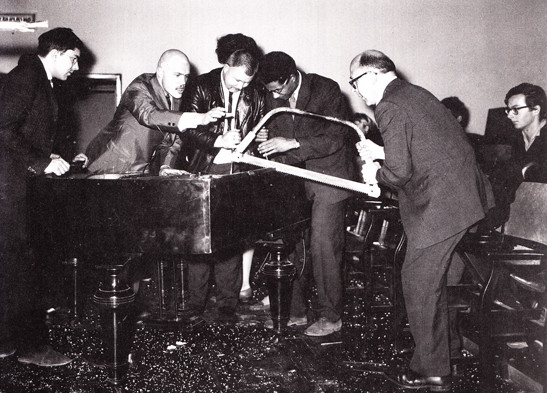
Piano Activities, International Festival of the Newest Music at Weisbaden Festum Fluxorum, 1962
Application Deadline Expired
Let’s make a band
Let’s Make a Band is a hands-on, playful and critical workshop where music and technology get tangled up in unexpected ways. Together, participants invent fictional - possibly improbable - bands, complete with genre, look, member personas, and the universe they come from. From there, the focus shifts to the instruments: what would this band actually play, and how would sound, bodies, and technologies relate within their invented musical world?
Participants will be introduced to unconventional design approaches like absurd making and Dalcroze estrangement, and get hands-on experience with the Bela platform - a maker tool designed specifically for building interactive musical instruments. No prior experience with electronics or prototyping is needed. Participants collectively sketch, build, and play, culminating in a short gig where newly prototyped instruments are presented.
Beyond making, the workshop is a chance to collaborate with musicians, artists, researchers, and makers, learn from a group of experienced mentors, and leave with new skills, new ideas, and new friends.
Featured Mentors
- Tove Grimstad Bang is a Postdoctoral researcher at IRCAM, in the ISMM (Sound Music Movement Interaction) team. Working in Human–Computer Interaction, her research revolves around interactive technology in contexts of music and movement practice.
- Robert Jack is co-founder and director of Bela, where he works on product design and development for a range of open hardware tools and electronic musical instruments. He completed his PhD on the sense of touch in digital musical instrument design at the Centre for Digital Music (QMUL).
- Giacomo Lepri is a musician and researcher whose work investigates the socio-cultural implications of digital instruments - combining sound art with critical/speculative design research. He is currently a MSCA Fellow at the University of Genoa, examining digital lutherie practices in higher education.
- Andrew McPherson is a Professor in the Dyson School of Design Engineering at Imperial College London, where he leads the Augmented Instruments Laboratory. He brings a background as a composer, viola player, electronic engineer and HCI researcher to the design and critical study of new instruments.
Throughout the workshop, the fantastic members of the Augmented Instruments Laboratory will be on hand to support and collaborate with participants.
Workshop structure and resources
Preparation task: participants are asked to bring a prompt - an object, fabric, sound recording, drawing, word, or any other small token - that resonates with the imaginary band they dream about. It should feel like a fragment of the world their band might belong to. The prompt serves as a starting point for collective imagination, a creative anchor that helps ground the speculation and open up the world of the band.
The workshop’s activities alternate between doing and showing: short sessions of collective making followed by moments of reflection and presentation. Each day runs from 9:30 to 17:00 - though afternoons may linger.
| Day 1 | Day 2 |
|---|---|
| Welcome (9:00 am) | Bela Snippet |
| Dream the Band Up | Making |
| Lunch | Lunch |
| Pretending Imaginary Sounds | Making |
| Bela Snippet | Making |
| The Choreography Around the Instrument | The Debut |
The workshop will be held at Imperial College London - South Kensington campus, London.
The tools and materials provided to the participants will include:
- basic prototype materials (e.g. cardboard, foam, cork, wire, tape, string, paper, plastic bottles, elastic bands, metal tins, balloons, hot glue, zip ties, velcro, binder clips, staples, aluminium foil, markers, stickers, buttons)
- textile materials (e.g. conductive wires, fabrics, leather)
- basic circuitry and sensors
- Bela maker platform (to be returned at the end of the workshop)
If needed, participants are encouraged to bring any particular tool or material (subject to communication with the organising committee - see Application Form above) and use any open-source or free resource. The workshop is free and open to participants aged 18 and over. We are unable to reimburse any expenses (e.g. travel or accommodation) for accepted participants.
From the initial gathering of ideas to the final presentation of artefacts, core elements of the event will be collaboration and mutual support. The organising committee will try its best to welcome and make everyone comfortable. Cordiality and sharing are therefore expected from all participants as well.
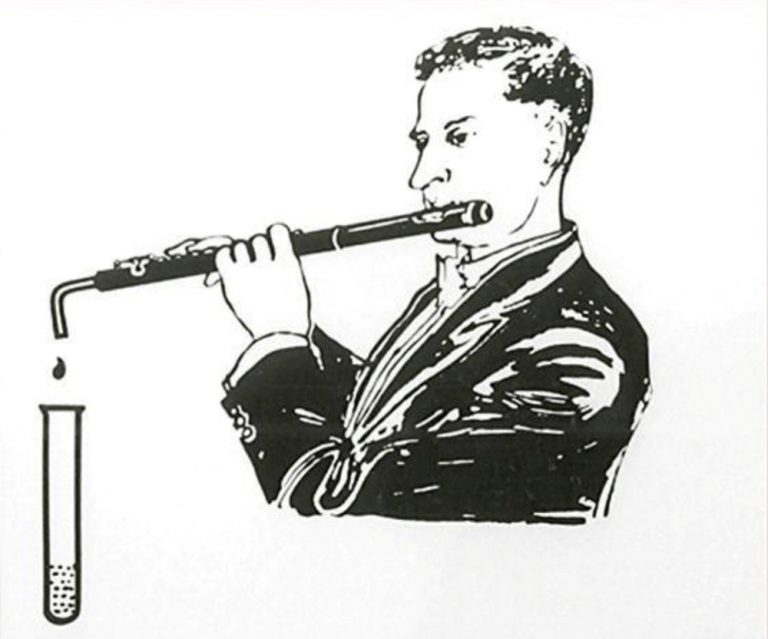
George Brecht, Chemistry of Music, 1969 - fluxusisland.org
For the curious
The workshop is grounded in the idea that musical instruments are never just tools - they carry with them histories, assumptions, and ways of thinking about sound, bodies, and culture. So, what happens when we invent a musical universe that doesn’t exist, and build instruments for that universe? By sidestepping familiar music-technology categories like controller, mapping, or sound generator, the workshop treats instrument design as something that emerges from socio-cultural imaginaries rather than technical convention.
The workshop draws together different sources of inspiration: music practices such as Dalcroze eurhythmics, and critical, speculative and participative design methods, such as pastiche scenarios and ustopian design. It treats fictional bands not merely as characters but as whole worlds - with their own internal logic, cultural texture, and contradictions - from which instruments can emerge. It is conceived to foreground the situated knowledge and experiences participants bring into the room.
This event is part of DECODMI (Discovering Education in Communities of Digital Musical Instruments), an MSCA-funded research project. The designed artefacts and the reflections around them may contribute to generating methodological intuitions, heuristics or provocative statements to be shared with broader research communities. Outcomes, ranging from methods to design processes, will be disseminated through academic publications with a strong multidisciplinary outreach.
- Magic Machine Workshops
- Absurd Music Hackathon
- 10.000 Instruments Workshop
- Stupid Shit No One Needs
- Can Knowledge be (a) Performative?
- Speculative Everything
- Dreamscapes of Modernity - Sociotechnical Imaginaries and the Fabrication of Power
Front images credits: Charlotte Moorman and Nam June Paik performing Art by Telephone - Museum of Contemporary Art Chicago (MCA) 1969.
The workshop is supported by the European Union’s Horizon 2020 research and innovation programme under the Marie Skłodowska-Curie grant agreement No 101150317 (“DECODMI”) hosted at the University of Genoa.