Jordie Shier
PhD Student
2022 — present
j.m.shier@qmul.ac.uk
Links
Interests
Jordie Shier is a fourth year PhD student in the Artificial Intelligence and Music (AIM) programme based at Queen Mary University of London (QMUL), studying under the supervision of Prof. Andrew McPherson and Dr. Charalampos Saitis. His research is focused on the development of novel methods for synthesizing audio and the creation of new interaction paradigms for music synthesizers. His current PhD project is on real-time timbral mapping for synthesized percussive performance and is being conducted in collaboration with Ableton. He was a co-organizer of the 2021 Holistic Evaluation of Audio Representations (HEAR) NeurIPS challenge and his work has been published in PMLR, DAFx, NIME, Frontiers, and the JAES. Previously, he completed an MSc in Computer Science and Music under the supervision of Prof. George Tzanetakis and Assoc. Prof. Kirk McNally.
Before starting postgraduate studies Jordie produced and performed electronic music in Canada, performing in the dance music duo Napoleon Skywalker with Carson Gant. With Napoleon Skywalker, Jordie used Ableton Live and synthesizers to create live remixes and new compositions with Carson Gant on drums. He has also performed live with modular synthesizers in various projects including Garden City Disco and in solo projects.
Jordie has been involved in multiple start-ups including a drum education start-up and helped produce two drum education series and the Drumeo Kids app for Drumeo.
Research Interests
From the first time I used a synthesizer, I was fascinated by the process of creating new sounds and exploring the unique sonic worlds that different synthesizers and controls enabled. Sound design and synthesizer interaction have remained central to my work throughout both my Master’s and doctoral research.
During my Master’s degree, I investigated how machine learning could support musicians in navigating the complex space of synthesizer parameters in novel ways. This led to the development of spiegelib (Synthesizer Programming for Intelligent Exploration, Generation, and Evaluation), a library designed to support research in this area. At the same time, I became interested in differentiable digital signal processing (DDSP) and GPU-accelerated synthesis, which enable deeper integration of synthesizers with machine learning workflows. Together with Joseph Turian and Max Henry, I created torchsynth as a contribution to this space.
I’m broadly interested in the computational representation of sound and how different representations can support different tasks. During my Master’s, I was a co-organizer of the Holistic Evaluation of Audio Representations (HEAR), a benchmark that challenged machine learning researchers to develop learned audio representations capable of generalizing across a wide range of tasks—from musical pitch recognition to bioacoustic analysis, such as assessing the health of a beehive from an audio recording. The affordances and limitations of audio representations have continued to be a central theme in my doctoral research, where I explore percussion timbre as an expressive quality that can be transferred from acoustic instruments onto synthesizers.
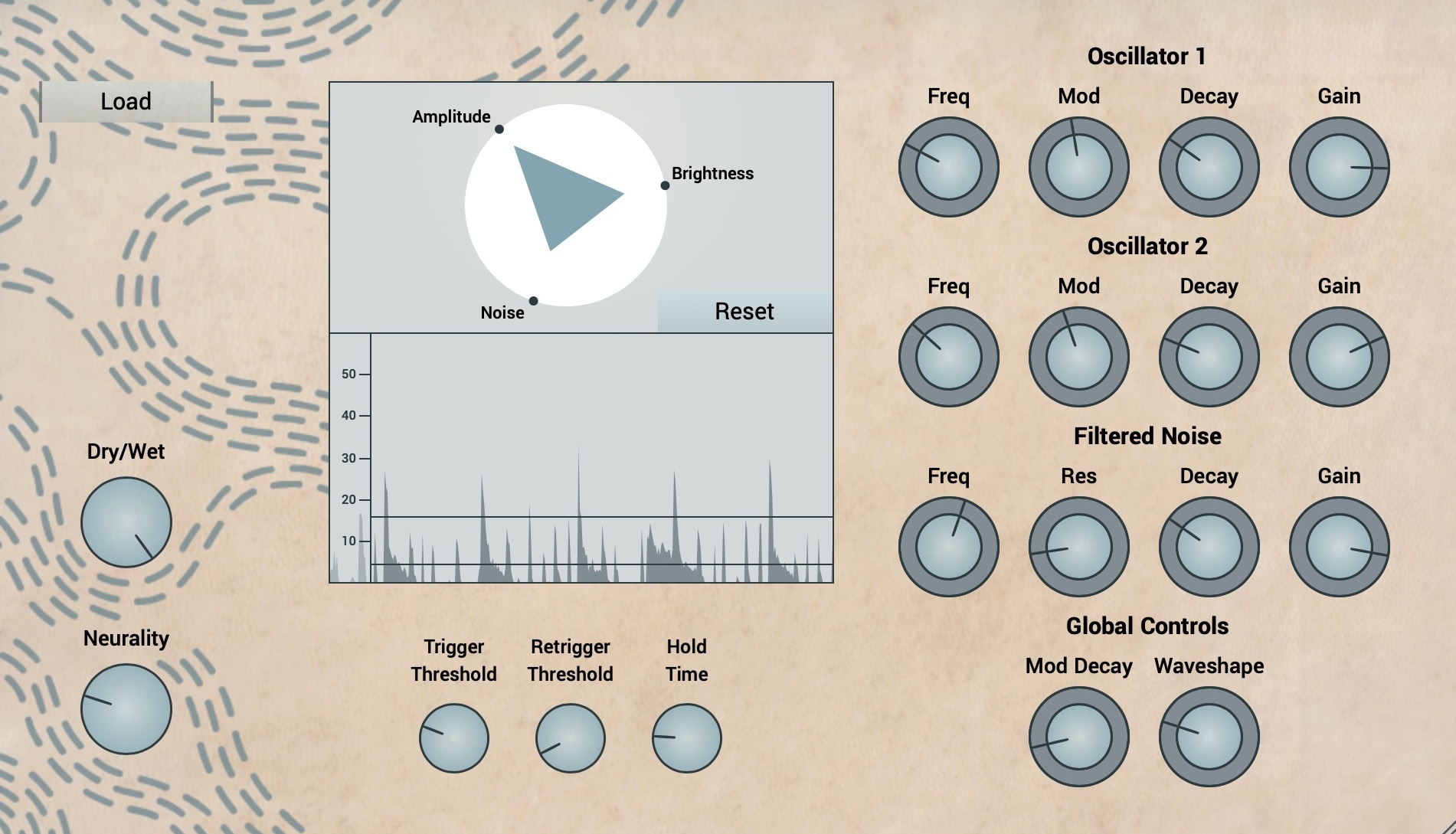
In my PhD, I have focused on real-time interaction with audio synthesizers, specifically exploring audio-driven control from live percussion performance. This research builds on my previous work using machine learning to navigate synthesizer parameter spaces, and is informed by my musical background performing as a synthesist alongside live drummers. Over the first two years of my PhD, I deepened my engagement with DDSP, co-authoring a review on the topic with Ben Hayes and co-presenting a tutorial on DDSP for Audio Synthesizer Programming at ISMIR 2023. At NIME 2024, I presented a system for real-time timbre remapping using DDSP, which integrates these concepts into a functioning system implemented as an audio plugin that I now use in my own musical practice.
While much of my research has focused on the control of traditional audio synthesizers—those commonly used in digital audio workstations (DAWs)—I have also explored neural audio synthesis (NAS). NAS systems use neural networks to synthesize audio directly and are trained on datasets to reproduce sound. These models offer novel interaction possibilities that are difficult to achieve with traditional synthesizers. Alongside fellow Augmented Instruments Lab member Franco Caspe, I’ve worked on two NAS-focused projects: drumblender, a hybrid NAS system for decomposing and recombining percussive audio components for creative synthesis; and BRAVE, a re-design of the popular RAVE model to support low-latency interaction for real-time musical use.
Lately, I’ve become increasingly interested in the process of designing new musical instruments and the limitations of purely technical approaches in addressing the complexities of musical practice. Objective metrics—while useful during system development or model training—often fail to capture what matters in live performance. As engineers of new musical instruments, how do we grapple with the divide between our tools and metrics, and the aesthetics and values of a specific musical context? This question has led me to explore how practice-based techniques can be integrated with technical research to bridge these worlds more meaningfully. In a recent NIME paper co-authored with percussionist and researcher Rodrigo Constanzo, we explored the role of audio features in timbre remapping for percussion instruments. Our collaboration involved alternating periods of technical development with studio-based reflection drawn from Rodrigo’s practice. I’m excited to further develop this approach—where musical practice is treated as an integral component of technical research—in the final stages of my doctoral work.
Academic Qualifications
— BSc Combined Computer Science and Music, University of Victoria
— MSc Interdisciplinary Computer Science and Music, University of Victoria
Projects