Sarah Angliss
PhD student
2025 — Present
s.angliss25@imperial.ac.uk
Links
Interests
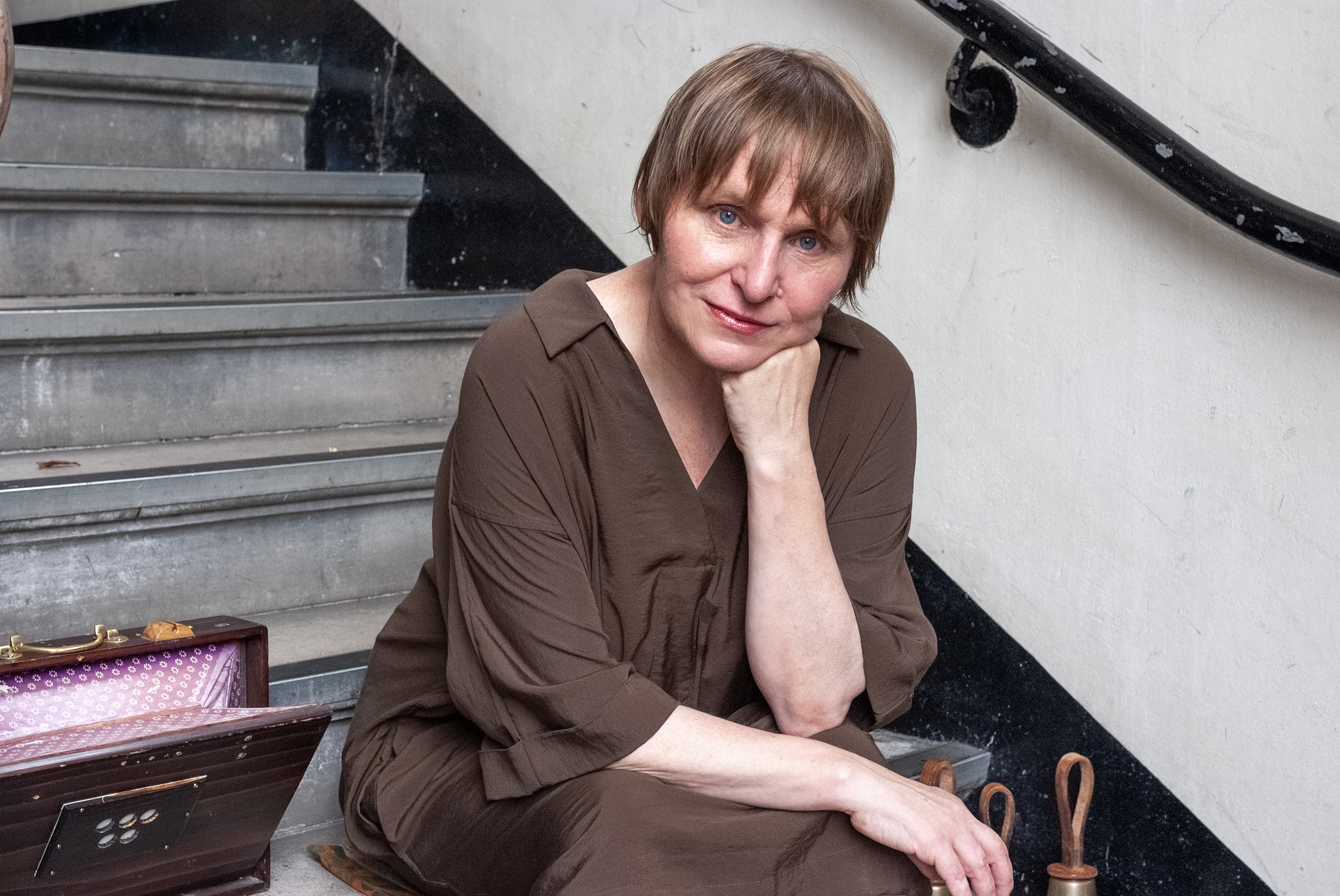
Sarah Angliss is an Ivor Novello Award winning composer, technologist and sound designer, creating new music and soundworlds for film, theatre, opera, dance, installations and her own live performances. Her music explores the sonorities of voices and instruments, revealing and augmenting them with her DIY musical automata and custom electronic techniques.
Sarah’s work reflects her unusual musical background. A classically-trained composer and performer who specialised early in baroque and renaissance music, Sarah cut her teeth performing on the UK folk scene. Her desire to get inside notes and finely manipulate sound led her to study electroacoustics then robotics and artificial life alongside music—a combination that enables her unique compositional voice.
As an historian of sound culture, Sarah often draws on primary archival sources to take a long view of more recent developments—from the introduction of the sampler, to the roots of industrial music and the technospiritual fantasies of the AI evangelists. Through archival research, she’s reconstructed the sound onboard a WWII-era submarine and machine-inspired dance fermented in early nineteenth-century cotton mills (with Dr Caroline Radcliffe). She’s also brought a 1970s algorithmic dance score of painter Chana Horwitz to life (with choreographer Ellen Davis). She’s created music for voice and mini-Oramics machine (built by Dr Tom Richards) and was invited by the Daphne Oram Trust to write a short biography of Oram to appear in the reprint of Oram’s An Individual Note of Music, Sound and Electronics.
On BBC Radio 4, Sarah has researched and presented documentaries on the social history of the echo and on the use of trained songbirds as early domestic sound recorders. Her early experimental concerts, in collaboration with the National Physical Laboratory, Prof. Richard Wiseman and others, in which the Purcell Room was laced with pure infrasound, were reported worldwide.
Sarah’s research has always informed her compositional practice. Her electroacoustic score for Eugene O’Neill’s Expressionist masterpiece The Hairy Ape (directed by Richard Jones) featured at The Old Vic, London, and Park Avenue Armory, New York. Her filmscore for Romola Garai’s horror Amulet premiered at Sundance 2020. In 2023, her debut opera Giant opened Aldeburgh Festival (librettist Ross Sutherland, directed by Sarah Fahie). This electroacoustic opera transferred to the Linbury Theatre, Royal Opera House, in March 2024 after critical acclaim. She’s currently developing The Percipients, a new opera inspired by an occult find in the UK telecoms archives, in collaboration with the National Sound and Media Museum, director Stewart Laing, historians James Mansell, Annie Jamieson, Tim Boon and others. Sarah also plays live, often accompanied by her DIY musical automata. She’s performed at The Royal Festival Hall, Union Chapel, Arnolfini, Iklectik, LSO St Luke’s, Star and Shadow, BBC Halls Swansea, Acid Horse, Supernormal, Supersonic UK; Prima Vista, Estonia; National Sawdust, Brooklyn, and many other festivals and venues. She’s a recipient of an Ivor Novello Visionary Award, a Jerwood Opera Writing Fellowship and a Paul Hamlyn Award for Composers.
Projects
In the Augmented Instruments Lab I’m researching ‘lost alternatives’—forgotten devices that embody fascinating, unfamiliar approaches to sound. Over the next three years I’m taking a deep dive into three case studies, each of which is a lost alternative from the early digital era. The first of these is the digital work of composer and inventor Daphne Oram. In the 1980s, Oram attempted to transition Oramics, her electromechanical ‘drawn sound’ system into the digital domain.
In their paper Entangling Entanglement, Morrison and McPherson (2024) present a detailed critique of prevailing electronic instrument design. According to the authors, many DMI creators are stuck in a design rut, perpetually reworking instrument designs based on quantised pitches; tempered scales; and unidirectional sensors, mappings and actuators. This is partly due to commercial or aesthetic expediency —historically, for example, synths with organ-like keyboards found more customers (Pinch and Trocco, 2004). It can also be due to the borrowing of design paradigms from non-musical domains (e.g. telecoms) which then became adopted as defaults.
I see a deep and generous study (Noble, 1979) of forgotten, historic musical outliers as a way out of this design rut. This includes instruments that never quite ‘made it’—those that were never fully understood or appreciated; those that barely sold or were eclipsed by more popular rivals; those that never left the maker’s bench or were swiftly discarded when ‘improved’ models arrived or musical tastes changed. I refer to these as ‘forgotten’ instruments as most fell into obscurity.
To write off forgotten musical instruments as failures is unhelpful as it ignores the well documented entanglement of machines, their users and broader culture (Noble, ibid)—an observation at the heart of the UKRI Rudiments project, the home of this PhD research. A forgotten instrument, the soundworld it enabled and the culture that emerged around it, however briefly, may represent an artistically promising but overlooked ‘lost alternative’ approach to musical expression. Hence I see the three case studies at the core of this PhD as more than miscellanea—the ‘quirk history’ that Dolan (2015) describes. A rich seam of design data may lie dormant within each of them, embodying or encoding the values of its designer(s) and of the musical culture in which it was situated. I hope to uncover this by triangulating reverse engineering of its constituent parts with oral history interviews; design of derivative interfaces; objective acoustic analysis and reflective compositional practice, led by the original instrument’s affordances. All of these strands of enquiry can be regarded as elements of critical design practice (Teboul, 2020).
Forgotten instruments may deploy design strategies that diverge significantly from those in use today, particularly if the designer(s) had to find workarounds for technological limitations (e.g. limited RAM). The gap that exists between idealised systems diagrams and the function and materiality of a working physical machine may itself reveal crucial design subtleties that have been lost. Thus, they may be particularly helpful sources of inspiration for anyone wishing to escape the ‘essentialising quality to DMI discourse’ that McPherson describes (ibid).
I hope this exploration of ‘lost alternatives’ will help me and fellow instrument makers to escape some of the design ruts outlined in Entangling Entanglement. I also hope it can inform my own engagement with musical instrument design configurations and philosophies that are emerging due to the expansion of AI.
References:
Dolan, E.I. (2015). Musicology in the Garden. Representations, Vol. 132, No. 1, pp. 88-94
https://www.jstor.org/stable/10.1525/rep.2015.132.1.88
Morrison, L., and McPherson A. (2024). Entangling Entanglement: A Diffractive Dialogue on HCI and Musical Interactions. Proceedings of the 2024 CHI Conference on Human Factors in Computing Systems, 2024. doi: 10.1145/3613904.3642171
Noble, D.F. (1979). ‘Social Choice in Machine Design: The Case of Automatically Controlled Machine Tools, and a Challenge for Labor’. Politics & Society, 8(3-4), 313-347. https://doi.org/10.1177/003232927800800302 (original work published 1978). Reported in Braun H-J (ed), Symposium on 'Failed Innovations' (May, 1992)
Pinch, T. and Trocco, F. (1998). ‘The Social Construction of the Early Electronic Music Synthesizer’. Icon, Vol. 4, pp. 9-31. Published by: International Committee for the History of Technology (ICOHTEC) http://www.jstor.org/stable/23785956.
Teboul, Ezra Jérémie. A method for the analysis of handmade electronic music as the basis of new works. Diss. Rensselaer Polytechnic Institute, 2020.
Academic Qualifications
BEng(hons) Electroacoustics, University of Salford
ARCM(Perf) Baroque and Renaissance Music, Royal College of Music (external candidate)
MSc Evolutionary and Adaptive Systems, University of Sussex