Project
Accessible Instruments
For over a decade, lab members have worked closely with disabled musicians and community groups to address persistent access barriers to playing musical instruments. Here we summarise some of the research and co-design activities we have undertaken to adapt existing instruments and create new ones which are more inclusive for musicians with diverse access needs.
The work presented here includes the PhD theses of lab alums Jacob Harrison and Eevee Zayas. Our collaborations with disability arts charities such as The OHMI Trust and Drake Music are ongoing.
The health, social and psychological benefits of music making have long been recognised, and well researched in the fields of music therapy, neuroscience, psychology, sociology and other disciplines. For disabled people, opportunities to partake in music-making activities can be impeded by social, attitudinal and physical barriers. The lack of instruments accessible to people with disabilities is one such barrier. ‘Accessible Instruments’ is the term used here to describe instruments which are designed specifically to accommodate the access needs of disabled musicians.
Performance-Focused Accessible Instruments
Many accessible instruments, particularly within academic research, place a focus on therapeutic, rehabilitative or other medical benefits of music-making. Often, a player’s encounter with these instruments is aimed to show improvement in an underlying condition, such as improved muscle control following a stroke or a therapeutic sensory response in children with profound and multiple learning disabilities (PMLD).
In contrast, there is little literature on accessible instruments designed purely for the purpose of musical performance. For non-disabled musicians, performing music is not an explicitly therapeutic act (despite its widely recognised health-benefits), and nor should it be for disabled musicians. This research focuses on the design of ‘Performance-Focused Accessible Instruments’ - new instruments designed explicitly for the purpose of fulfilling the same musical, social and cultural roles as existing instruments, while taking into account the access needs of disabled musicians.
We have developed a number of prototypes and finished instruments over the years. Wherever possible, these projects are co-creations with community organisations or individual disabled musicians.
The Adapted Bass guitar
The Adapted Bass is the result of a 6-month research placement with The OHMI Trust. The brief was to design an instrument to submit to OHMI’s accessible instrument competition, which focuses on instruments that can be ‘played without the use of one hand and arm’.
Our target was electric bass. Like most instruments, the bass guitar requires two hands to play, and so the first major design problem was to decide which hand to ‘replace’ or adapt: the fretting hand or the plucking hand. We conducted a survey of bass guitar players to assess their most-valued features of bass playing, and which hand those features relate to. We found that for bassists, performance elements relating to rhythm, timbre, timing accuracy and dynamics were generally more important than note choice and articulation. This led us to design a mechanical fretting system, preserving the role of the plucking hand while letting the player use an external electronic controller to choose which note to fret.
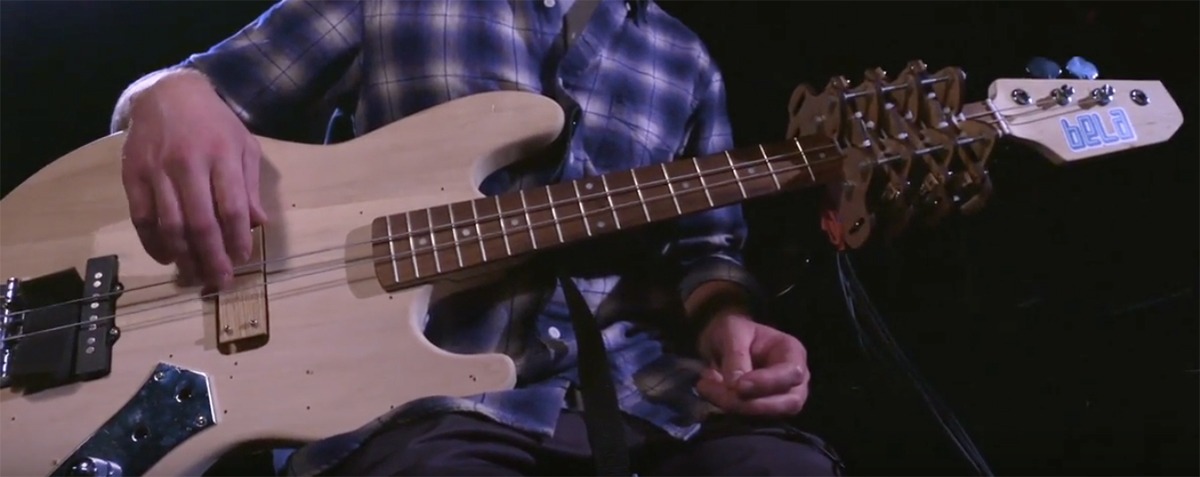
This project reached a proof-of-concept stage and featured in public demonstrations, though the final design proved too mechanically cumbersome to deploy widely. From a research perspective, the project was useful in demonstrating the extent to which an instrument can be modified and adapted before it loses its identity. Despite a large portion of bass playing technique becoming mechanised, the adapted bass remained recognisable as a bass guitar. This led us to think about the ways that an instrument’s overall aesthetic qualities (global form) and the more micro-level details of interaction (interaction modality) affect a player’s perception of the instrument’s musical acceptability.
Read more about the adapted bass guitar on the Bela Blog or watch the BBC Teach episode on YouTube.
-> Publication: 'Adapting the bass guitar for one-handed playing'
Strummi
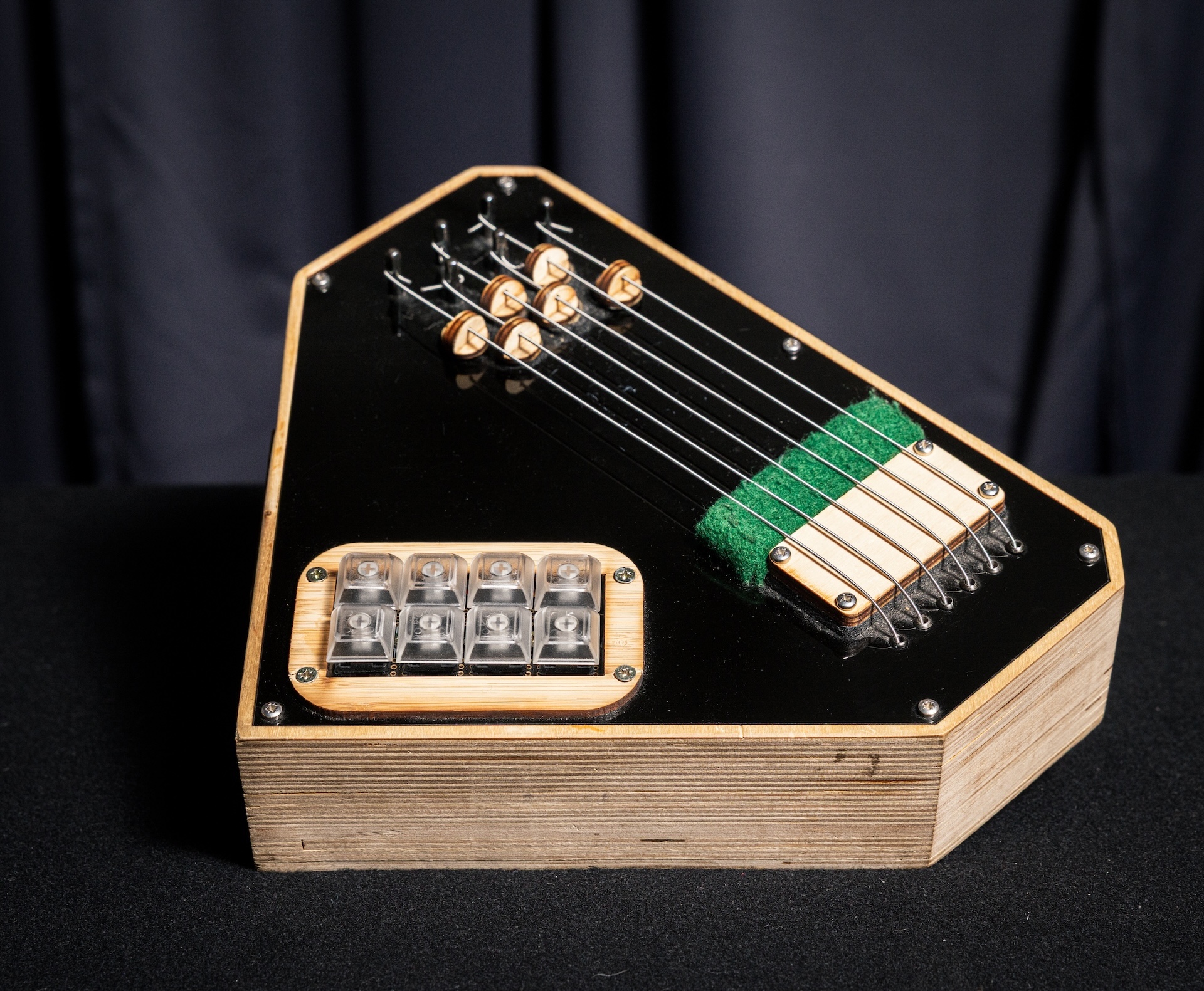
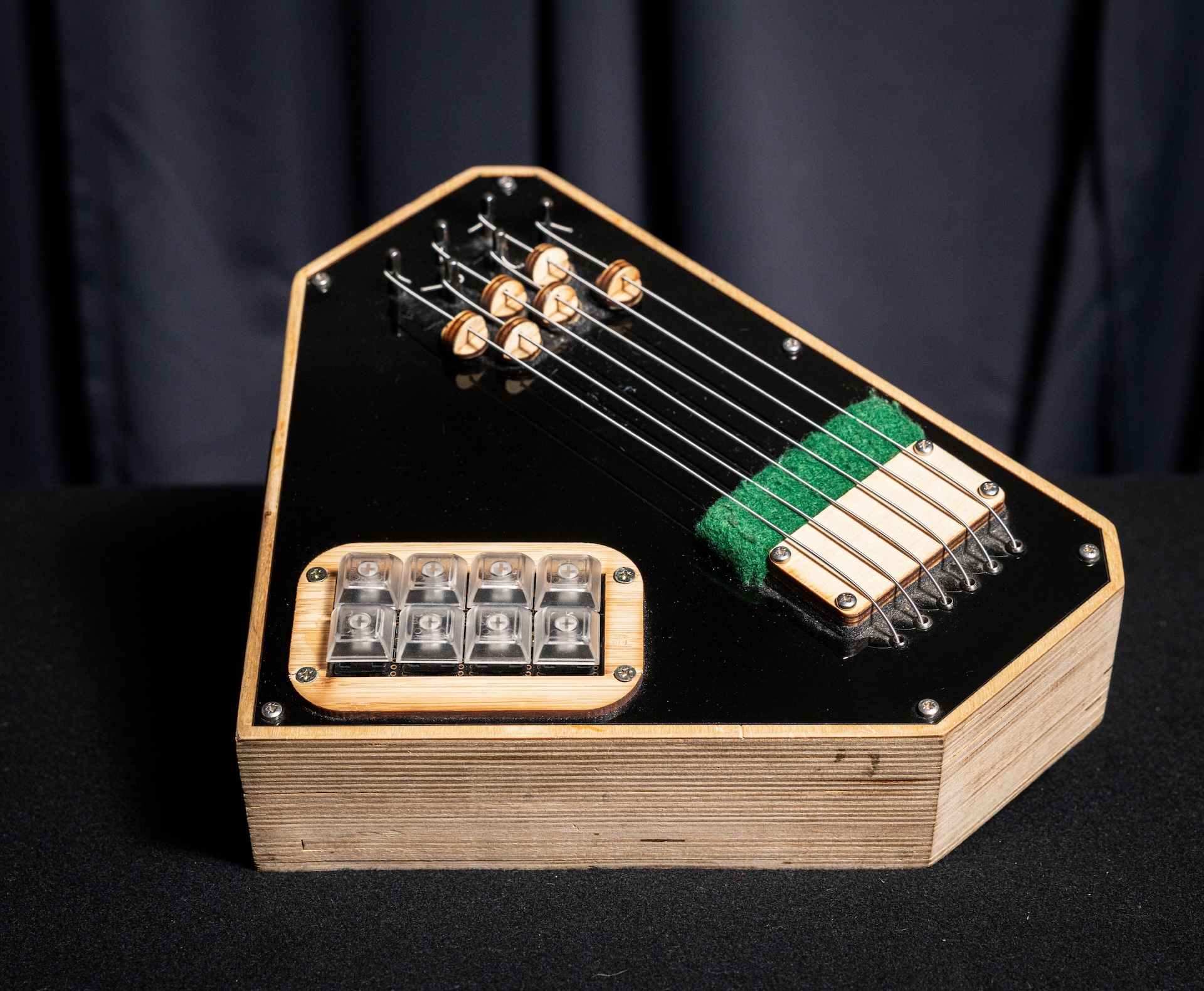
Strummi is a digital plucked string instrument which shares certain sounds and techniques with guitar playing while presenting a simpler interface similar to an autoharp. A notable feature of Strummi is its rich coupling between physical strings and a digital sound synthesis algorithm, where the fine nuances of how the string is plucked translate into variations in the sound of the digital synthesis.
Strummi was originally developed by PhD students Jacob Harrison and Robert Jack. It has gone through several iterations over the years, evolving from a laboratory prototype for testing design hypotheses to a community-focused accessible instrument and, in the PhD research of Eevee Zayas, a vehicle for exploring questions of replicability in digital musical instrument design.
Exploring Instrument Form and Interaction
We began with a research question about what matters most for a guitar-like digital instrument to succeed. Is it more important that it shares familiar guitar-like playing techniques, or is it more important that the physical form of the instrument looks like a guitar?
We tested this question by creating four guitar-like digital instruments, spanning two physical forms and two interaction modalities. Two of the instruments had a guitar-like body, while the other two had small tabletop form factors. Meanwhile, two of the instruments had six short lengths of damped guitar strings that could be plucked or strummed, while the other two had a touch sensor to activate the sound. All four instruments used the same sound synthesis model based on the classic Karplus-Strong algorithm.
In a study with experienced and novice guitarists, we found a wide range of opinions of which instrument most resembled a guitar, including suggestions that the look of the instrument and its playing techniques were not as separable as we thought. In a follow-up study, we also tested variations of whether having a more nuanced relationship between the string-plucking action and the resulting sound made the instrument more appealing. We found that experienced guitarists universally preferred the richest coupling between action and sound while novices tended to prefer the simpler relationship.
-> Read more about our investigations of guitar-like instruments: “When is a Guitar not a Guitar? Cultural Form, Input Modality and Expertise”; “Democratising DMIs: the relationship of expertise and control intimacy”
Strummi as an Accessible Instrument
Strummi in both its tabletop and guitar-body forms was used during sessions with Heart n Soul, a creative arts charity for people with learning disabilities. This was a long-term study as part of Jacob Harrison’s PhD thesis which explored the role of instrument design in removing barriers to music making for people with learning disabilities and how to preserve the social role of existing instruments such as the guitar in this context.
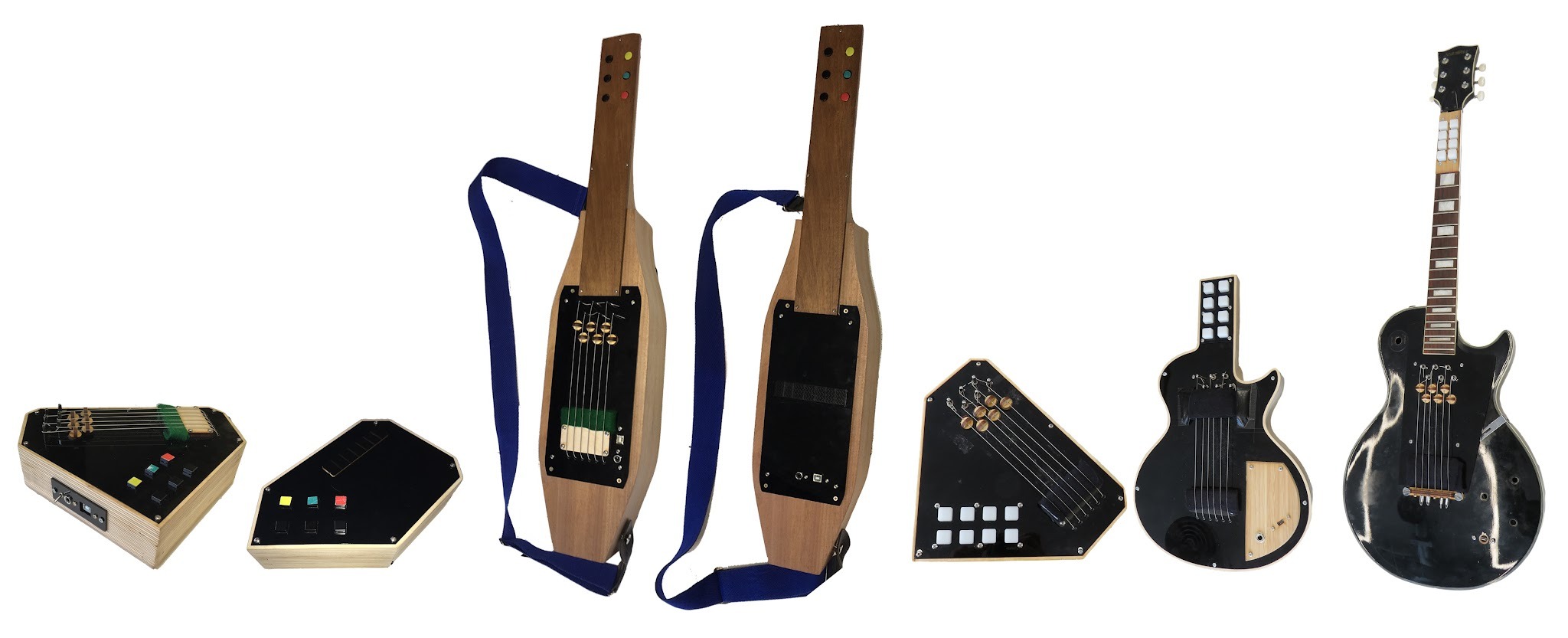
As part of this research, we conducted further redesigns of the Strummi, improving the chord-selection buttons and exploring design variations involving a Les Paul-style body.
-> Read more about Strummi and Heart n Soul: "Instruments, Ecosystems and Access: ADMIs in the Wild"
Strummi as Reproducible Research
Most new musical instruments fall out of use after only a few years, for a combination of technical and commercial reasons. In research, instruments tend to disappear when designs are poorly documented or difficult to replicate. The poor longevity of new instruments is a vexing problem in accessible music communities when what is needed is not a transient quick fix, but a sustainable design that can carry someone through many years of music-making.
Eevee Zayas addressed this challenge as part of their PhD in accessible instrument design, proposing the idea of digital musical instrument ‘apprenticeship’, where hands-on design knowledge is passed down in the workshop and not only through research papers. To demonstrate the concept, Jacob and Eevee worked together to replicate Strummi, and Eevee subsequently worked with another collaborator to replicate Eevee’s own instrument.
-> Read more about replicating Strummi: "DMI Apprenticeship: Sharing and Replicating Musical Artefacts"
Dialogic Design and the Capacitive Touch Guitar
Eevee Zayas’s PhD includes an extended collaboration with a musician who was a keen guitar player before a severe injury left them without the finger strength to manipulate the strings. Eevee explores the musical potential of dialogic design, a form of participatory design that calls attention to the way that designers and users each bring their own creative ideas to the table, promoting a multidirectional flow of ideas and lived experience rather than an exercise in eliciting and fulfilling specifications.
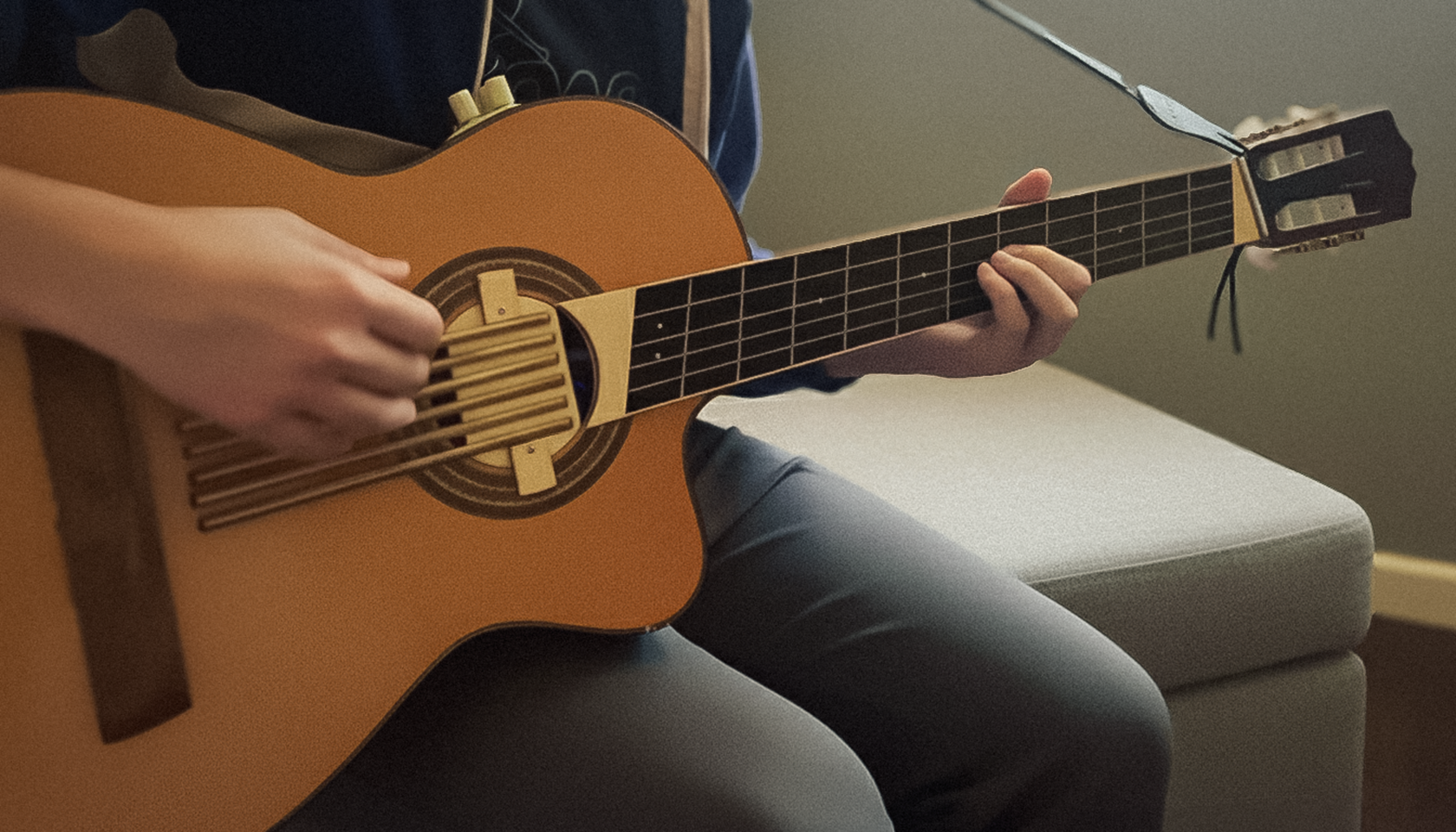
Through extended dialog and multiple rounds of design probes and research prototypes, Eevee created the Capacitive Touch Guitar, a digital string instrument within an acoustic guitar body. Instead of having physical strings, the Capacitive Touch Guitar features touch sensors on the fretboard for selecting notes and chords and six brass rods which activate the string sound when touched. A vibration transducer attaches to the soundboard of the guitar so that the sound is produced internally to the instrument without external speakers.
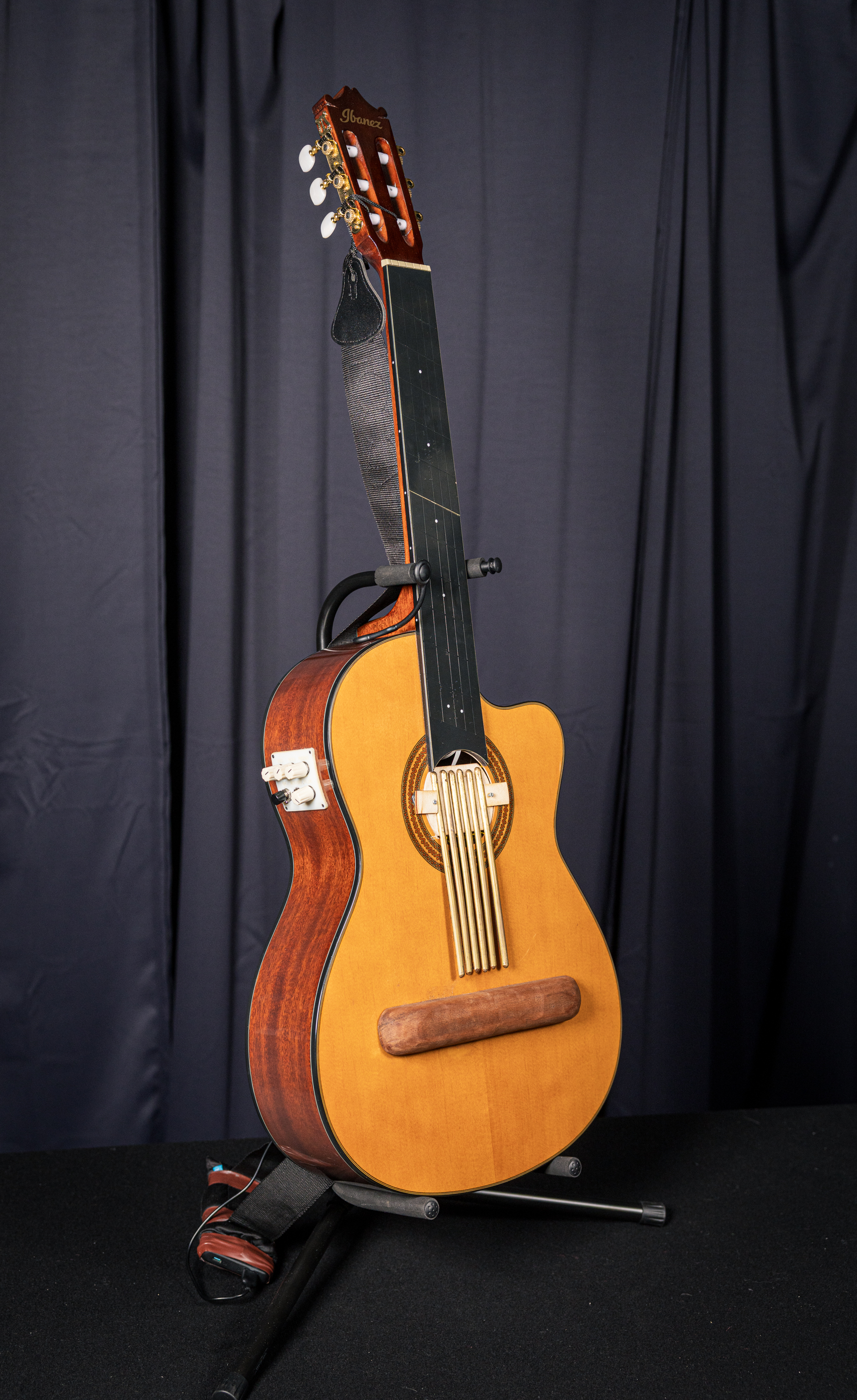
Like the original research study behind Strummi, the Capacitive Touch Guitar shows how digital instruments can build on familiar instrumental forms and playing techniques while changing some of the physical properties of instruments that make them inaccessible to some musicians.
More information on the Capacitive Touch Guitar will be in Eevee’s PhD thesis, to be published soon.
-> Read more about dialogic design: "Dialogic Design of Accessible Digital Musical Instruments: Investigating Performer Experience"
Partnerships
Following the disability rights adage “nothing about us without us”, it is crucial that disabled musicians are closely involved in any research which addresses or affects them. Conversely, it’s important to avoid hasty technical “solutions” to problems which non-disabled designers imagine that disabled people might face.
In a 2024 AHRC-funded research network in collaboration with Birmingham City University, we facilitated a series of workshops to bring together disabled and non-disabled voices across disciplines to map out some of the artistic, technological, social and ethical challenges in this space.
-> Read some of the research network’s provocations for accessible instrument design.
The lab’s research in accessible instrument design is always undertaken in collaboration with relevant organisations and individuals. We maintain close links with the OHMI Trust, specialising in adaptations of traditional classical instruments for musicians with limb differences or motor impairments, and Drake Music, home of the DMLab community of accessible instrument designers.