Project
Bidirectional Tactile Interaction in Digital Instruments
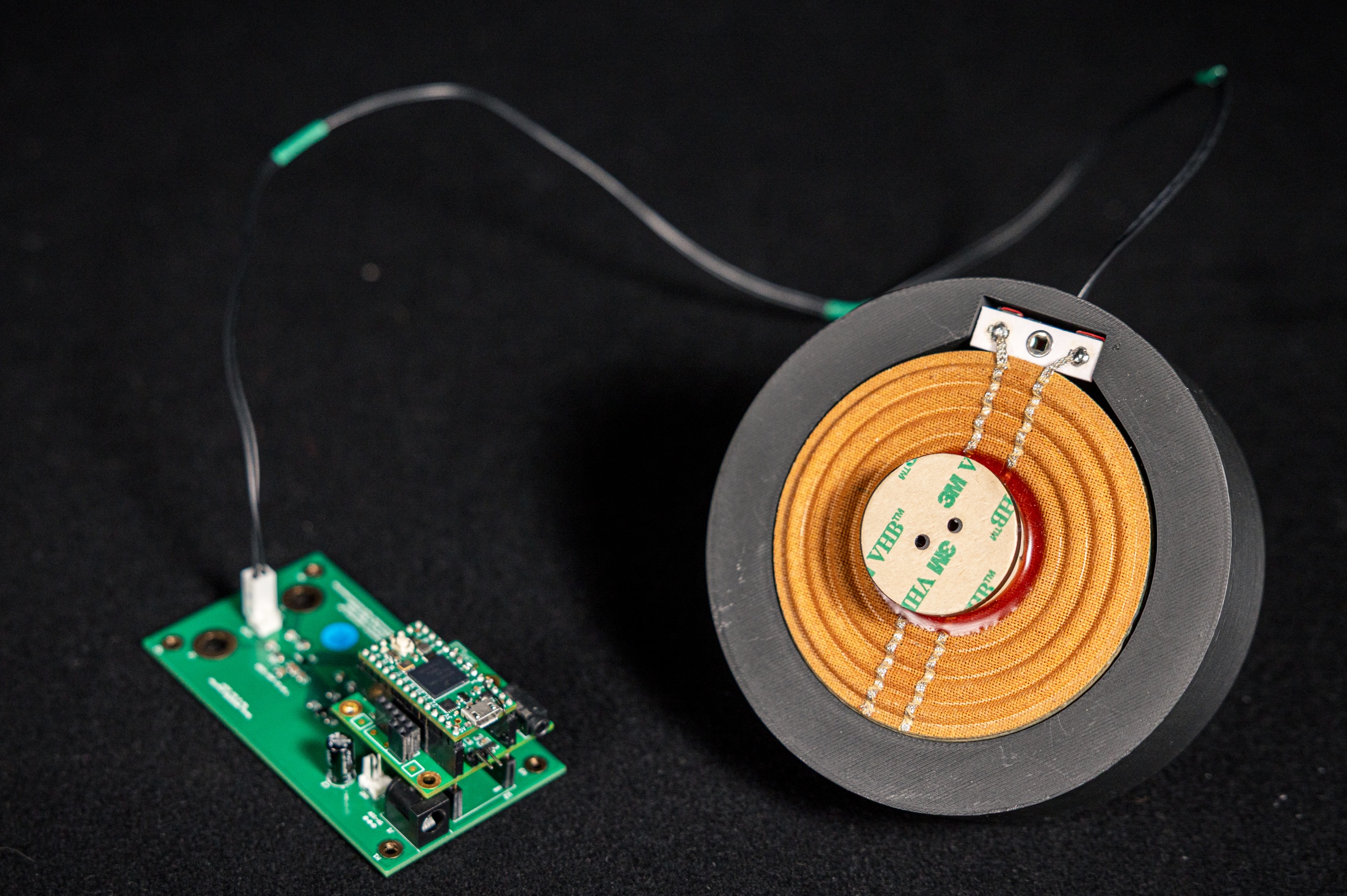
Matthew Davison's PhD research is centred on haptic feedback and bidirectional interactions between the physical and digital domains within digital musical instrument (DMI) designs. This involves the creation of the HaptiCoupler system – to explore how DMI designs are changed by bidirectional tactile interaction – alongside exploring other novel sensing and actuation techniques.
Conventional DMI design will often follow a unidirectional paradigm; sensors capture musical gestures and this data is then mapped to synthesis parameters. The reality of interaction with musical instruments is, of course, less straightforward. In reality, there is a coupling between the musician and the instrument that is bidirectional – the musician is affected by the instrument and its physicality as well as the musician affecting the instrument through gesture.
This PhD project aims to explore this idea of bidirectionality – where the boundary between the musician and the instrument in the tactile domain does not enforce a certain level of unidirectionality. Through the use of high bandwidth inputs and outputs (using audio signals rather than the frequently used approach of discretisation to MIDI notes, for example), a certain richness may be obtained from musical interactions.
Matthew has investigated this idea, and the effect on instrument designs, through a user study involving experienced DMI designers using the HaptiCoupler system. Published in CHI (Conference on Human Factors in Computing Systems), this study explored how the bidirectional audio-rate interaction has the potential to 'remutualise' audio and vibrotactile haptics, as well as changing interactions techniques and musical gestures.