Research
The Somatechnics of Musical Instrument Design
The technical level of design and engineering issues in digital musical instrument design, like accessibility, sustainability, ergonomics, or marketability disguise more fundamental narratives surrounding what and who a musician can be. Critical discourses like Trans Studies, Crip Theory, and Feminist HCI are reshaping how we think about designing technology in conversation with bodies. The study of technique in particular demonstrates the entangled reality of musicians' bodies with musical instruments, social contexts, and cultural hegemonies.
This PhD project follows the development of the Digital Vocal Instrument Ephemerides through autobiographical design. First-person experiences of vocal dysphoria inform design decisions of the instrument. Ephemerides foregrounds techniques from gender-based voice training, in particular resonance training that aims to modify the size and shape of the vocal tract in speech. Extrapolating from this design of a social prosthetic, this work offers insights towards the emerging first-person research methods like soma design.
Listening & Somatechnics
Listening is where bodies, instruments, and sound fundamentally overlap. Listening is a practice that foregrounds the ways in which bodies, instruments, and sound form one another. Our traditional models of understanding listening as absorption or normative fall apart upon consideration of difference in culture, ability, and gender.
Listening is an apparatus. Listening practices, with or without technology, can actively shape and reshape imaginations, memories, and interactions with the world. Working with certain audio technologies demonstrates an ambiguity between listening, making music, and designing musical instruments. Finally, a tracing of accountabilities and responsibilities in designing musical instruments and working with machine listening can begin to formulate in considering how sound is produced and how sound is perceived.
The deep entanglement of musician and instrument is intuitive; one does not exist without the other [1]. We recognize, culturally, that the piano-player, for example, has certain abilities that are linked specifically with the piano, and that the piano through the centuries is shaped and redefined by the musicians who play it. More-than-human uderstandings of the body, however, present a more literal understanding that what we consider “the body” or “bodies” is not entirely socially constructed nor biologically determined [2]. Bodies in this sense are continually constructed, performative, and relational, not unlike musical instruments. A more precise term, forwarded by Nikki Sullivan and Samantha Murray, is the term ’somatechnics’, to describe the inextricability of techné and soma in formation of bodies. Soma, in this example, is the piano-player, and techné is the piano-playing.
“This term, derived from the Greek sôma (body) and techné (craftsmanship), supplants
the logic of the ‘and’, suggesting that technés are not something we add or apply to the
body, nor are they tools the embodied self employs to its own ends. Rather, technés
are the dynamic means in and through which corporealities are crafted, that is, con-
tinuously engendered in relation others and to a world.” [3]
Somatechnics are a very broad concept and topic, and this PhD is focusing on a very particular aspect of it, as it relates to digital musical instruments. What’s important to me is how somat-
echnical narratives drive design decisions and music making practices, reproducing or disrupting modes of instrument making. To borrow a concept from Karen Barad, I think of this as a ‘material-discursive’ practice, as the discourse surrounding DMI design produces musician-instrument relationships and vice versa. The language we use to define material defines the material, and the material in turn defines the language we use to talk about it.
Examining aural perceptions through the lens of somatechnics provides a background for connecting listening with gender. Vocal Dysphoria, for example, is a specific condition that foregrounds the embodied and corporeal nature of listening. It's a condition that involves listening one's voice, but that listening process produces an internal dissonance that often presents as a barrier to speech, singing, or other social functions. I used my first-person experience of vocal dysphoria in the design of the musical instrument Ephemerides.
Ephemerides
Ephemerides [4] is an audio feedback instrument that does not require the vocal cords in order to sing. The link between the instrument, and the theories presented, is technique used in producing voice. Ephemerides foregrounds properties of vocal resonance (i.e. frequency response of the oral and nasal cavity) which are important to speech content and gender presentation, to elicit pitched sounds without engaging the vocal folds. A singing voice is produced through Ephemerides through defamiliarisation [5], appropriating resonance techniques from gender-based voice training. It is from technique, as both a technical means of sound making and a sociocultural means of understanding bodies [3], that we connect first-person practice with theories in design.
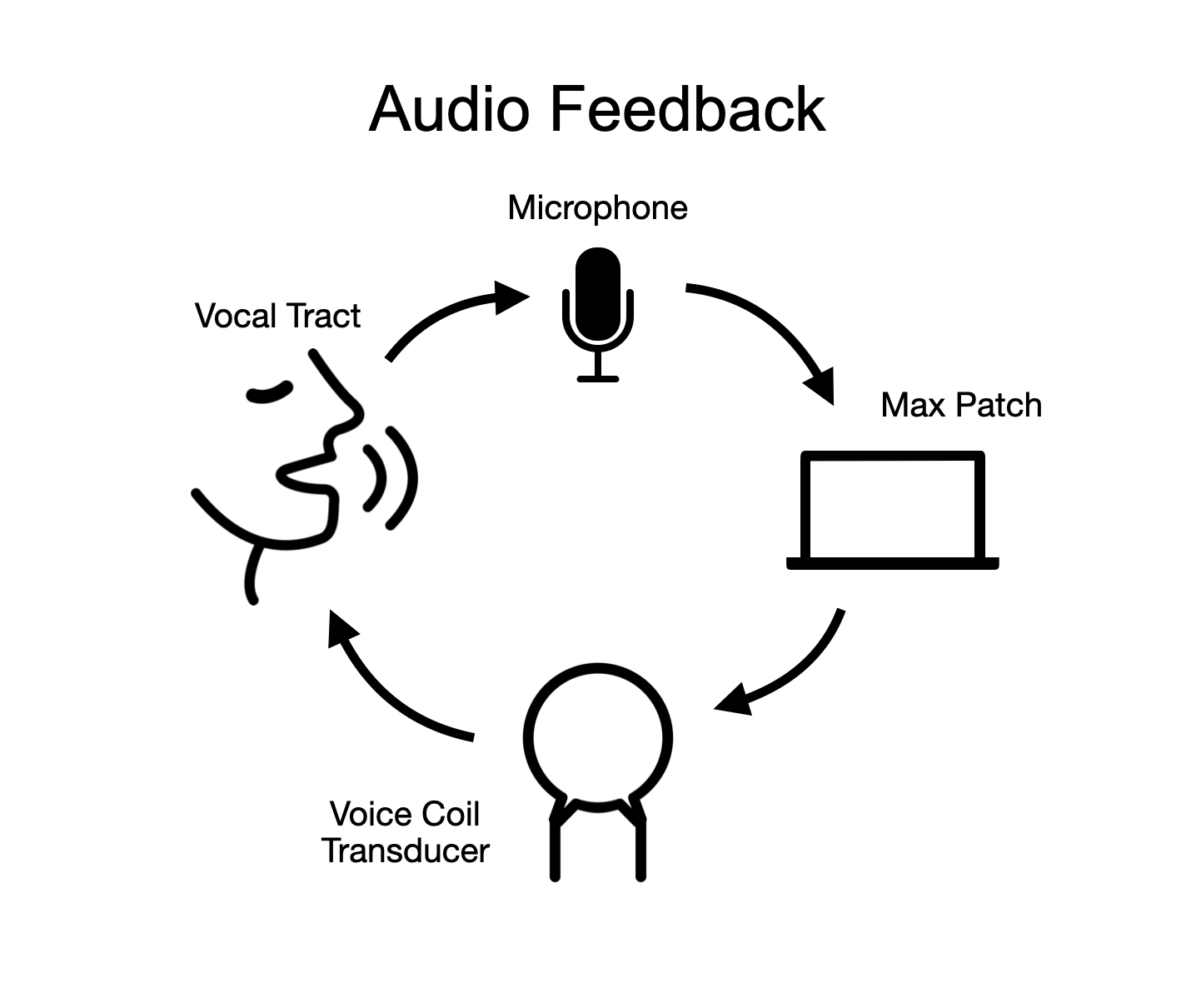
As part of the design process, after completing the initial prototype, I used Noticing [5] as a method to better understand my own vocal dysphoria. In the language of soma design, I position vocal dysphoria as a felt sense [6], or embodied knowledge that’s difficult to explain or reproduce with language. By spending time with a particular sensation and choosing language to describe it, “we can uncover nuanced aspects in our experiential relationship with the environment that are difficult to access through mere observation or analysis" [6].
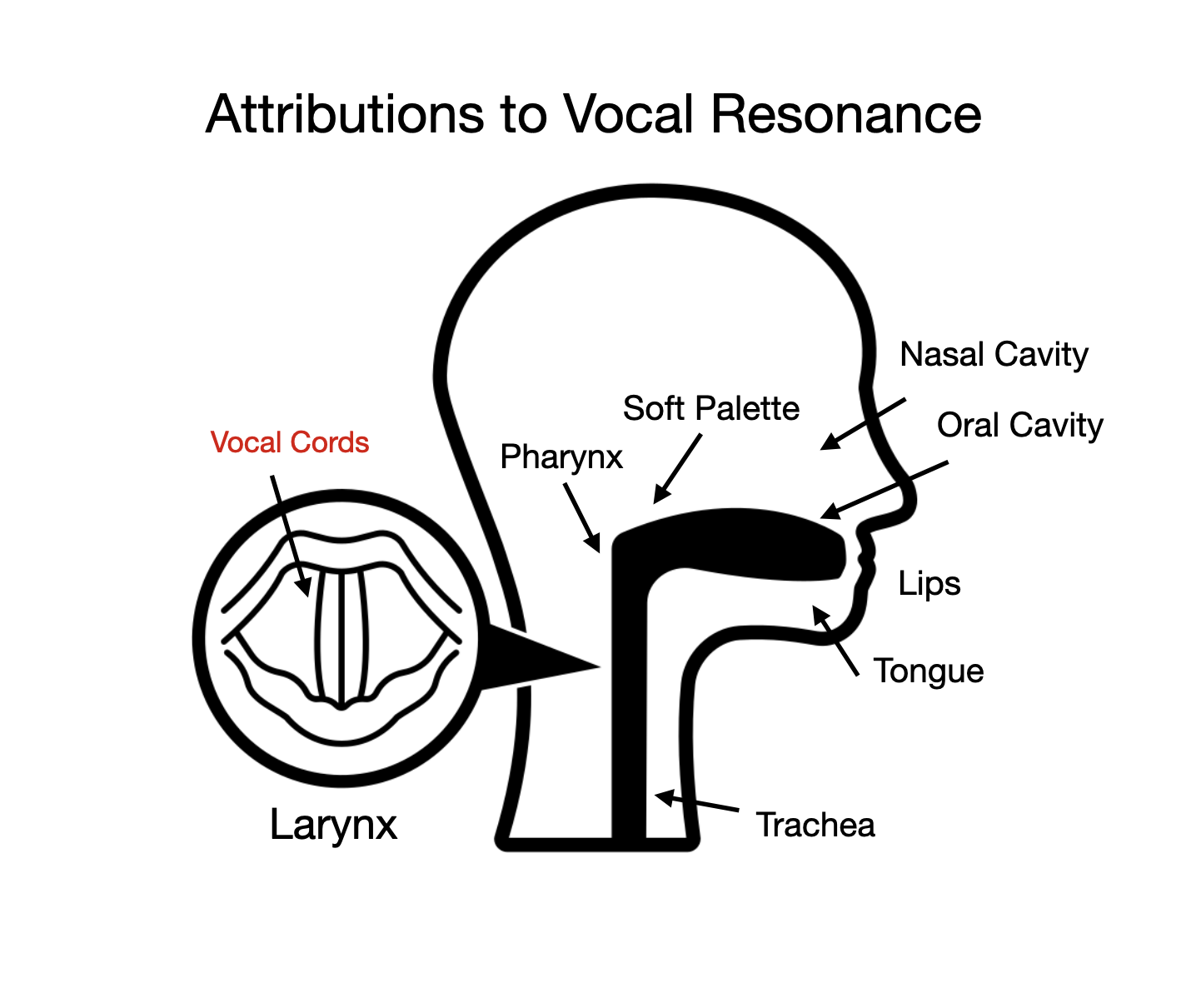
Despite its appropriation of technique from a therapeutic practice, Ephemerides is intended to function as a musical instrument. The sonification (in this case an unstable selection of pitch through audio feedback alone) of vocal resonance may be worthy of future research in therapeutic contexts, but our focus is situating this instrument within electroacoustic
music. Finding gender affirmation and reclaiming identity was very important to me, but without proper clarification of what affirmation meant in relation to my body, this terminology remained surface-level. For me, gender affirmation meant ‘feminine’, but an instrument design goal might be ‘adaptable’, ‘meditative’, or ‘engaging’. Embodied interactions with technology and practices produce more complex relationships than something that can classified as ‘affirmative’.
Ephemerides is prosthetic voice for myself in my own artistic practice. It doesn’t require me to use my vocal cords, eliminating what I often find dysphoric in singing. It is played through the manipulation of vocal resonance, a technique of my body that I use on a daily basis to express my gendered presentation. I draw similarities with it and Paul Preciado’s analysis of the first vibrating dildo as a synthetic sex organ, simulating the technique and motion of a masturbating
hand [7]. It further implies that sex and technology are irreducible, and that how we define sex depends on an ecology of sexual practices, whether that is assigning sex at birth, using sex toys, or redefining sex characteristics entirely.
Listening & Soma Design
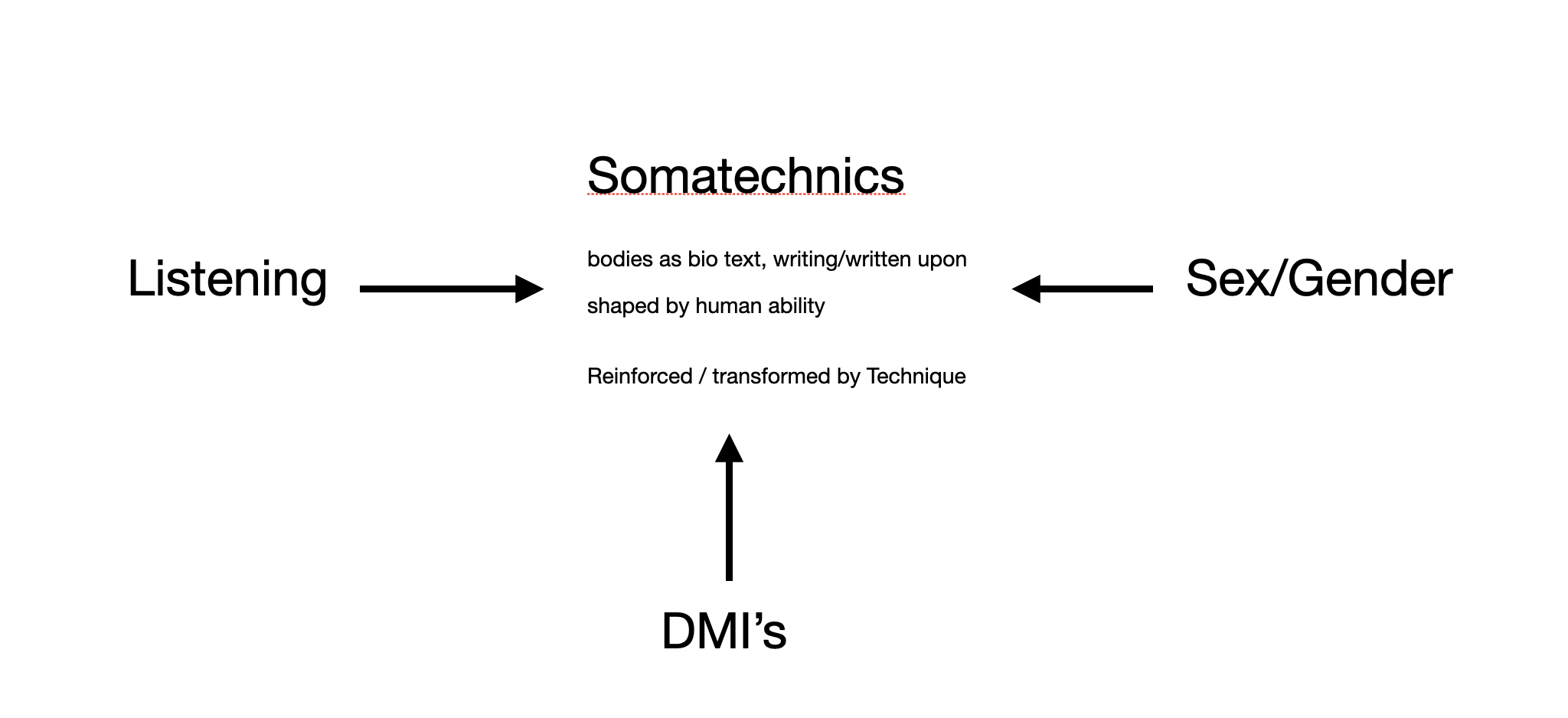
In my experience of designing Ephemerides, I appropriated Noticing, a soma design method inspired by Pauline Oliveros' Deep Listening philosophies. In general, there's a trend in soma design research that favors a particular mode of introspection over others. Listening, however, while metaphorically is part of the soma design process (i.e. listening to the body), listening as an aural sense is rarely engaged with in comparison to other senses like touch, emotional well being, or proprioception. Where soma design intersects with musical instrument design is usually breath (source) or muscle memory (source).
What makes listening a subject for soma design in ways that have not already been described? Study of somatechnics prioritises the poststructuralist understanding of bodies, in that they are not only continually created, morphing and changing, but bodies change directly through technique. Contemporary sound studies tend to agree, arguing that listening in an enactive process than a passive, unidirectional mode of information intake. The overall take is that inscribed within the act of listening is particular sociocultural mode of understanding the world.
References
Mice, L., & McPherson, A. P. (2022). Super Size Me: Interface Size, Identity and Embodiment in Digital Musical Instrument Design. CHI Conference on Human Factors in Computing Systems, 1–15. https://doi.org/10.1145/3491102.3517626
Homewood, S., Hedemyr, M., Fagerberg Ranten, M., & Kozel, S. (2021). Tracing Conceptions of the Body in HCI: From User to More-Than-Human. Proceedings of the 2021 CHI Conference on Human Factors in Computing Systems, CHI ’21, 1–12. https://doi.org/10.1145/3411764.3445656
Murray, S. (2016). Somatechnics: Queering the Technologisation of Bodies. Routledge. https://doi.org/10.4324/9781315609867
Kuhn, J., & McPherson, A. (2026). Ephemerides: A Microtonal Feedback Instrument Based On Transgender Voice Training Technique. 248–256. https://doi.org/10.5281/zenodo.20784113
Oliveros, P. (2005). Deep Listening: A Composer’s Sound Practice. iUniverse.
Wilde, D., Vallgårda, A., & Tomico, O. (2017). Embodied Design Ideation Methods: Analysing the Power of Estrangement. Proceedings of the 2017 CHI Conference on Human Factors in Computing Systems, CHI ’17, 5158–5170. https://doi.org/10.1145/3025453.3025873
Preciado, P. B. (2018). Countersexual Manifesto (K. G. D. F. by J. Halberstam, Trans.; p. 240 Pages). Columbia University Press.
Núñez-Pacheco, C., & Poikolainen Rosén, A. (2024). Articulating Felt Senses for More-Than-Human Design: A Viewpoint for Noticing. Proceedings of the 2024 ACM Designing Interactive Systems Conference, DIS ’24, 1029–1043. https://doi.org/10.1145/3643834.3661554