Teresa Pelinski
PhD student
2021 - present
t.pelinskiramos@qmul.ac.uk
Links
Interests
Teresa Pelinski is a PhD student at the Augmented Instruments Lab (Dyson School of Design Engineering, Imperial College London) and the Centre for Doctoral Training in AI and Music (Centre for Digital Music, Queen Mary University of London). During her PhD, she has been an associate lecturer at the Creative Computing Institute (University of the Arts London), a teaching assistant at Queen Mary University of London and Imperial College London, an intern at Bela and has been awarded an Enrichment Placement at the Alan Turing Institute (London, UK). Teresa holds a BSc in Physics (Universidad Autónoma de Madrid) and a MSc in Sound and Music Computing (Universitat Pompeu Fabra). Her PhD is supported by UKRI and Bela.
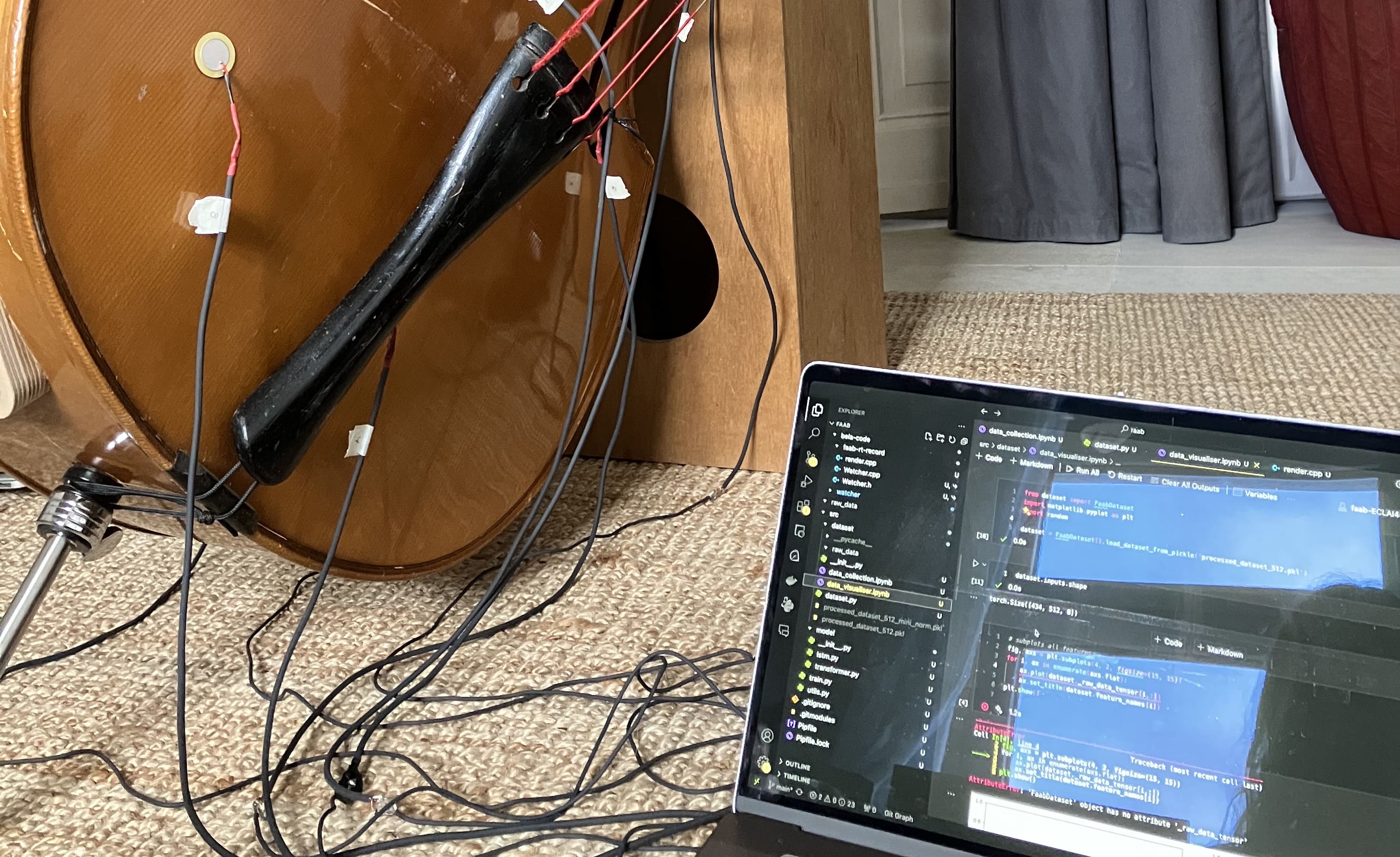
I find musical instruments are interesting technical objects, since they often embody alternative discourses to those typically associated with technology (progress? innovation?). In academic research, technical objects are typically presented as a contribution in themselves, with a description of functionality, methods employed, and evaluation metrics. While these are valuable contributions, I feel that, especially in creative scenarios (like instrument design!), the artefact itself is only a part of the story: in the process of building instruments, we dialogue with materials, embed our ideas of what technology is, what it could be.
During my PhD I have developed some tools to support prototyping with neural networks in embedded computers (in Bela!). This interest in technical practice has led me to incorporate practice research and STS perspectives into my work. I have been especially inspired by Andrew Pickering’s writing on scientific practice, and by the practice research community in the UK. From this critical standpoint, I have been interested in pushing back against the current large AI models trend, by working on lightweight, “prototypeable” models which become a material to play around with, a material whose properties we can explore – rather than a massive problematic black box.
Outside the lab, I enjoy self-hosting projects, cyberpunk science fiction, making candles and playing football.
Events (talks and workshops)
— Jourdan, T., Pelinski, T., Scurto, H. (2024). First-person and second-person perspectives for ML in NIME. International Conference on New Interfaces for Musical Expression. Utrecht, Netherlands (Workshop)
— Martin, C. P., Pelinski, T. (2024). Building NIMEs with Embedded AI. International Conference on New Interfaces for Musical Expression. Utrecht, Netherlands (Workshop)
— Pelinski, T. (2024). The dialectics of resistance and accommodation in the practice of debugging. Code as Conversation: Transmedia Dialogues Around Critical Code Studies (Conference presentation)
— Armitage, J., Shepardson, V., Privato, N., Pelinski, T., Benito Temprano, A. L., Wolstanholme, L., Martelloni, A., Caspe, F. S., Reed, C. N., Skach, S., Diaz, F., O'Brien S. P., Shier, J. (2023). Agential Instruments Design Workshop. AI and Music Creativity Conference. Brighton, UK (Workshop)
— Pelinski, T. (2022). Anomaly detection as means of sensing subtlety and nuance in musical gesture. in Embedded Perspectives of Musical AI Workshop. University of Oslo, Norway. (Workshop talk)
— Pelinski, T. (2022). Some considerations on the design of digital musical instruments. Jornada de Organología (Organology Seminar) at Universidad Complutense de Madrid, Spain. (Invited talk)
— Pelinski, T. (2022). Sensor mesh as performance interface. International Conference on New Interfaces for Musical Expression. (Doctoral consortium)
— Pelinski, T., Shepardson, V., Symons, S., Caspe, F. S., Benito Temprano, A. L., Armitage, J., Kiefer, C., Fiebrink, R., Magnusson, T., & McPherson, A. (2022). Embedded AI for NIME: Challenges and Opportunities. International Conference on New Interfaces for Musical Expression. Online (Workshop)
Academic Qualifications
— BSc Physics, Universidad Autónoma de Madrid
— MSc Sound and Music Computing, Pompeu Fabra University
Projects