Project
Augmented Violin
Violin-family instruments have remained nearly unchanged for centuries. Designing entirely digital replacements for bowed string instruments is extremely difficult, but the possibilities for hybrid acoustic-digital string instruments are vast. Over the years we have undertaken a number of research projects to investigate and extend violin-family acoustics and playing technique and to develop tools for addressing the instrument’s famously steep learning curve.
The svampolin: a hybrid acoustic-electronic violin
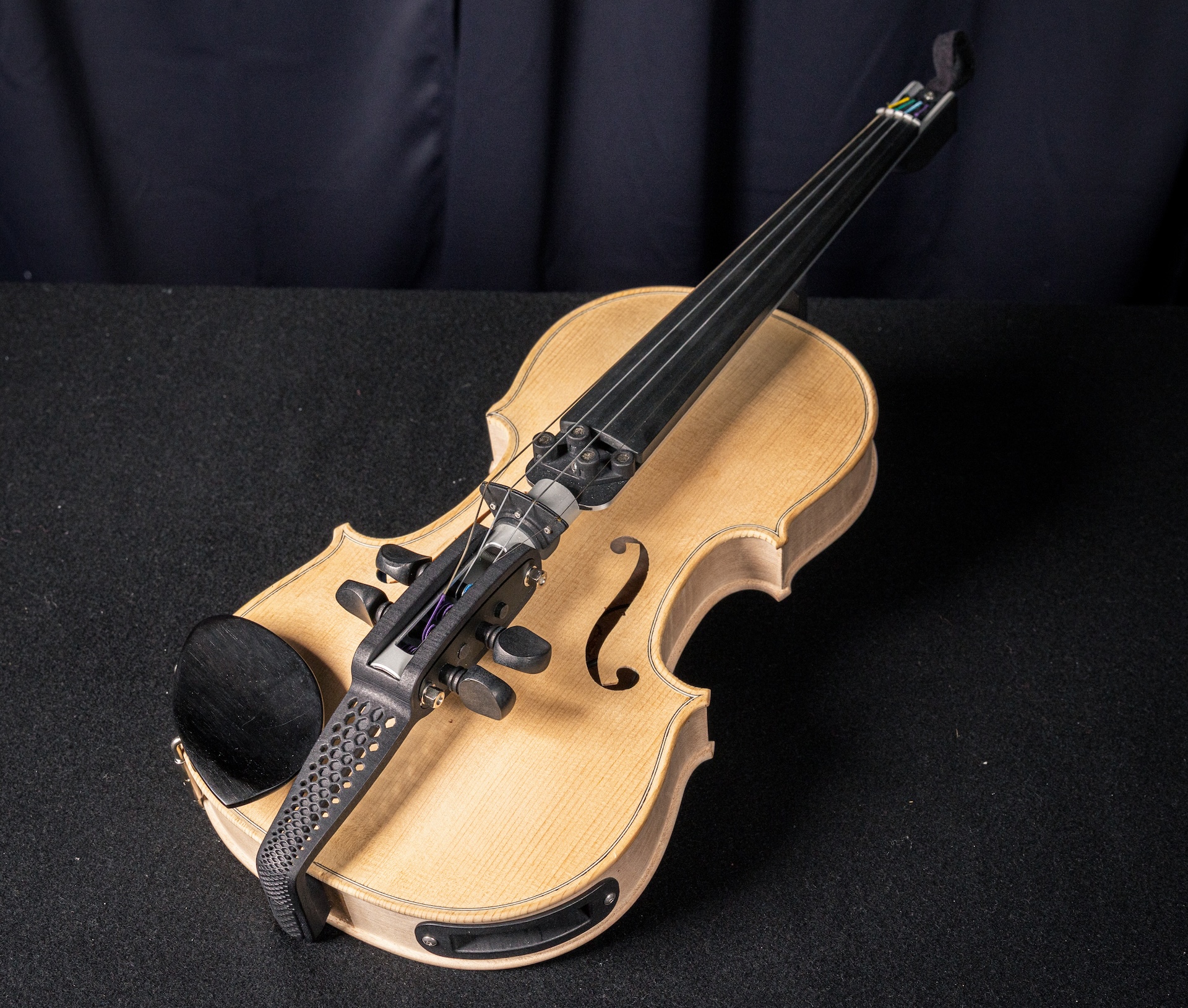
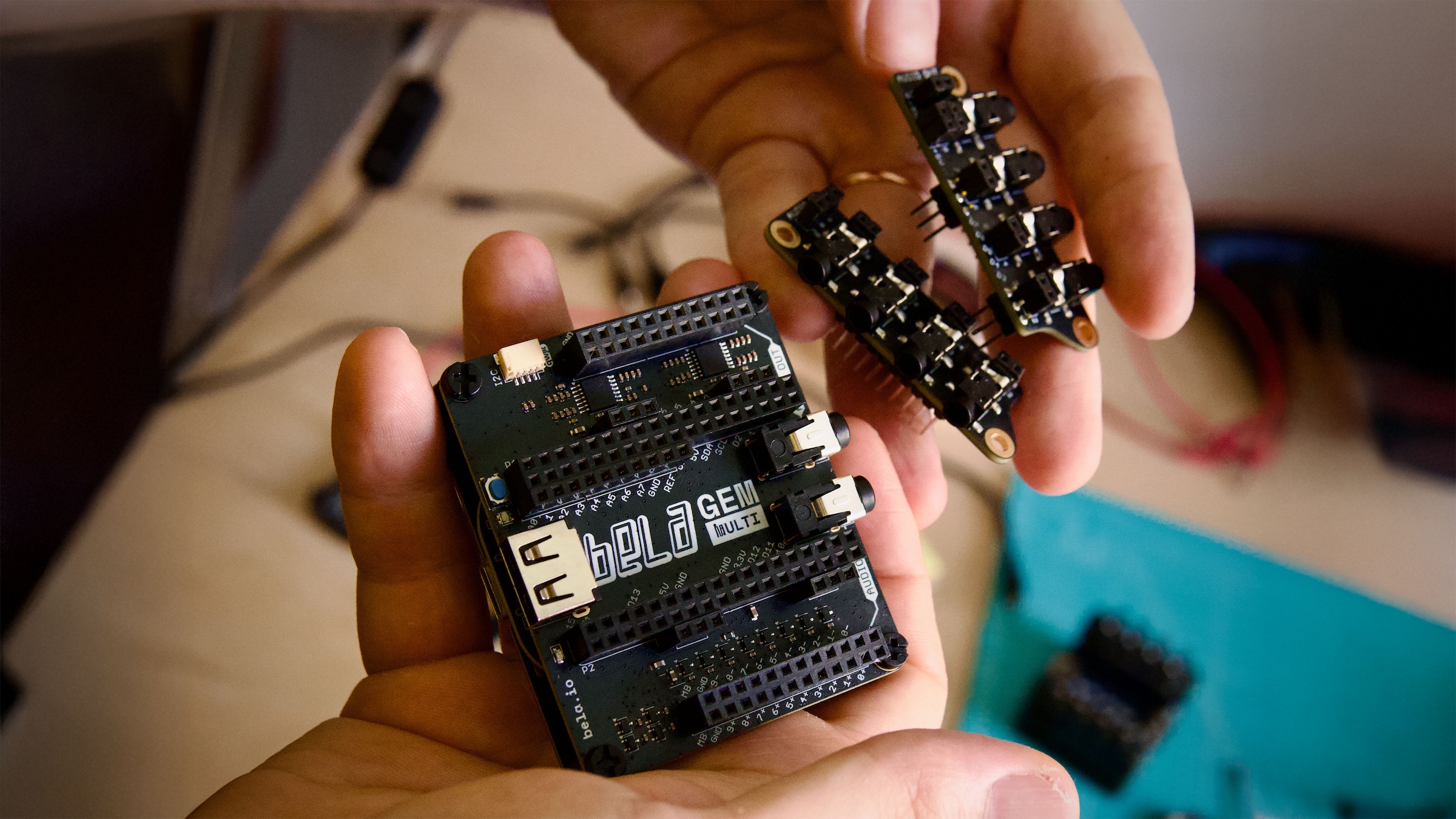
The svampolin, designed by Laurel Pardue and colleagues in collaboration with Dan Overholt at Aalborg University Copenhagen, acoustically decouples the strings from the body of the instrument: instead, the vibration of each string is captured by a separate pickup, and sound is produced by a vibration transducer mounted inside a separate violin body. In between, real-time audio processing running on [Bela](link to research page) can transform the sound of the instrument.
-> Read more about the svampolin: 'Separating sound from source: sonic transformation of the violin through electrodynamic pickups and acoustic actuation'
Low-noise, polyphonic string pickups
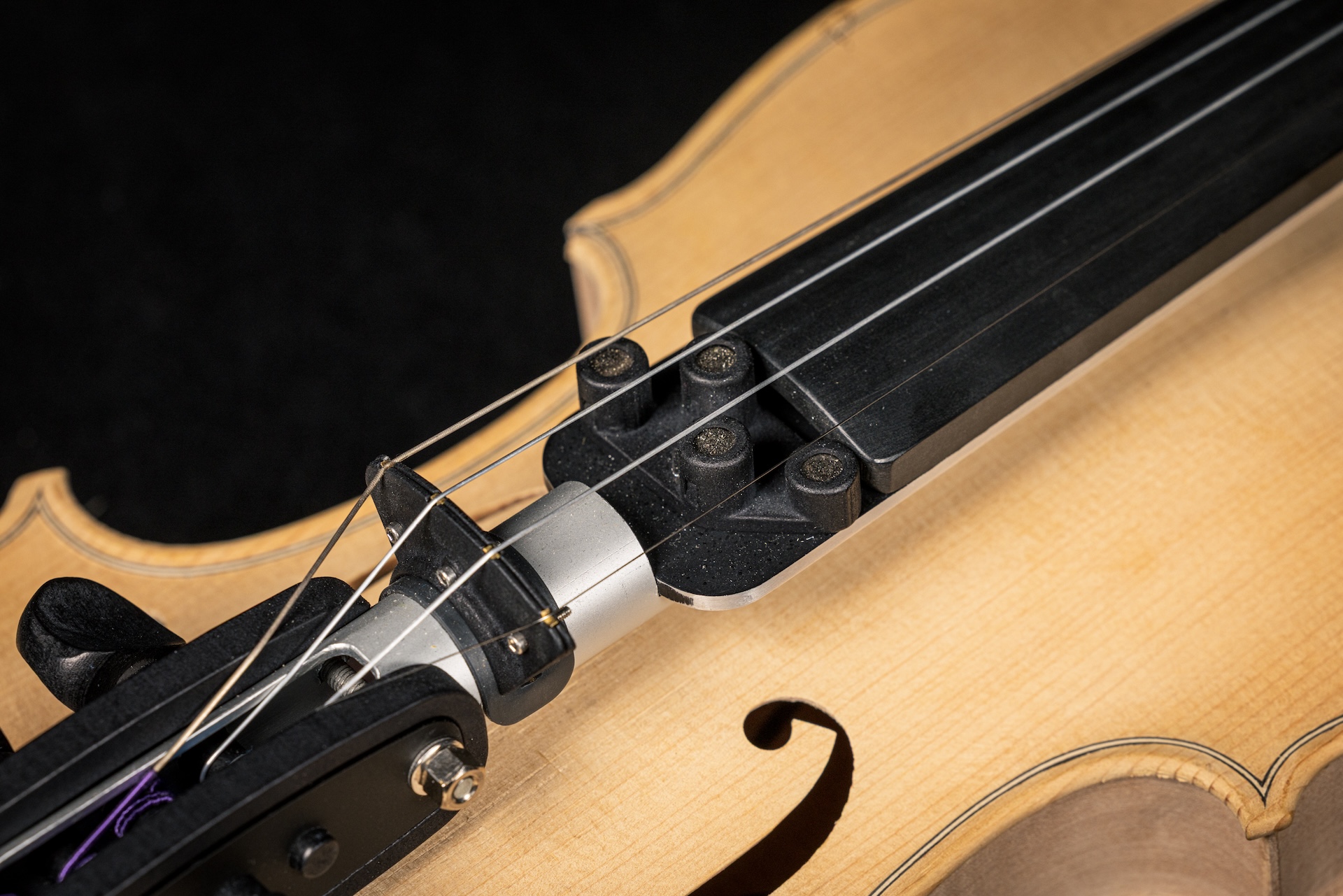
Inspired by a design by Michael Edinger, we created an electrodynamic pickup system for string instruments based on Faraday’s Law, where a voltage is induced in a wire moving in a magnetic field. Where typical magnetic pickups have a fixed coil of wire, here the string itself is used as the pickup. A permanent magnet is glued to the fingerboard near the string, and the movement of the string with respect to the magnet produces a very small voltage which is amplified by an ultra-low-noise preamp.
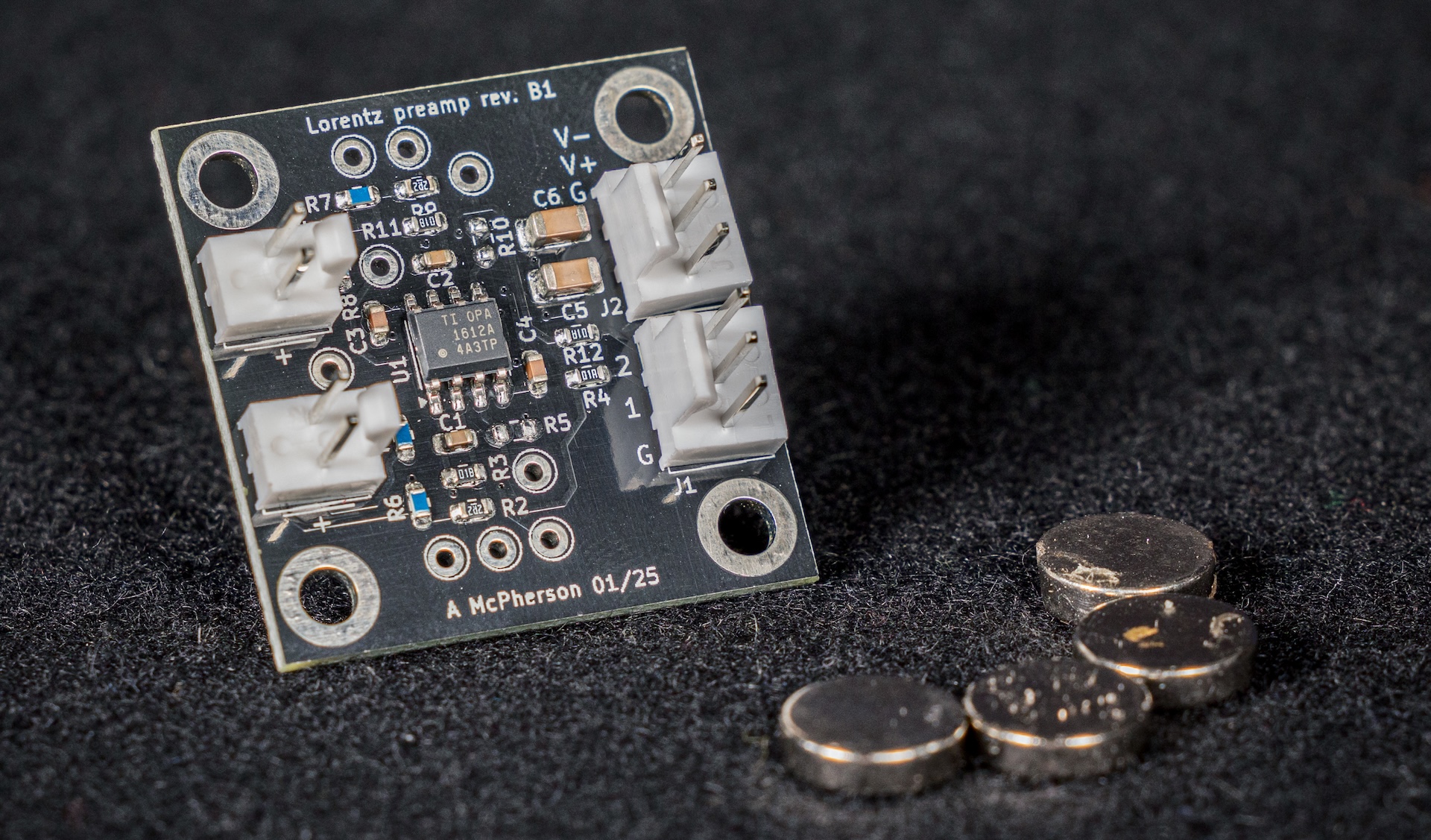
When applied to a violin-family instrument, this pickup has the interesting property of clearly showing the Helmholtz (stick-slip) motion of the bowed string. Changes in bow speed, pressure, position and direction have clearly observable effects on the output signal. We developed real-time signal processing systems for extracting these features and applying them to augmented violin performance.
We can provide prototypes of the pickup system for experimentation and performance applications. Contact us for more details.
-> Read more about the pickup system and analysing its signals.
Sensing fingerboard and bow technique
We developed a series of low-cost sensors for measuring a violinist’s actions on the fingerboard and bow. These include resistive linear potentiometers under each string to detect finger position and a method of detection bow position and pressure based on measuring the hair-to-stick distance at several points along the bow.
These methods allow lower-latency estimation of pitch and note onset events that audio-only methods would permit, while being cheaper to implement than optical motion capture or magnetic position tracking systems.
-> Read more about the sensors and performance tracking in:
'A low-cost real-time tracking system for violin', 'Low-latency audio pitch tracking: a multi-modal sensor-assisted approach', and 'Near-field optical reflective sensing for bow tracking'.
Technology-assisted violin learning
Learning a string instrument is difficult. Most people require many years of practice to achieve a good quality of tone production, which presents motivational challenges, especially for learning as an adult. Laurel Pardue’s PhD thesis examined how the sensor and signal processing technologies described here could be used to assist the process of learning violin. For example, low-latency pitch tracking can be used to apply pitch correction to the violin signal, either through the svampolin or through headphones, so that the result always sounds in tune. This temporarily frees the player to concentrate on bow technique and potentially makes early-stage violin playing more satisfying for the learning.
-> Read more in: Laurel Pardue’s PhD thesis