Project
Magnetic Resonator Piano
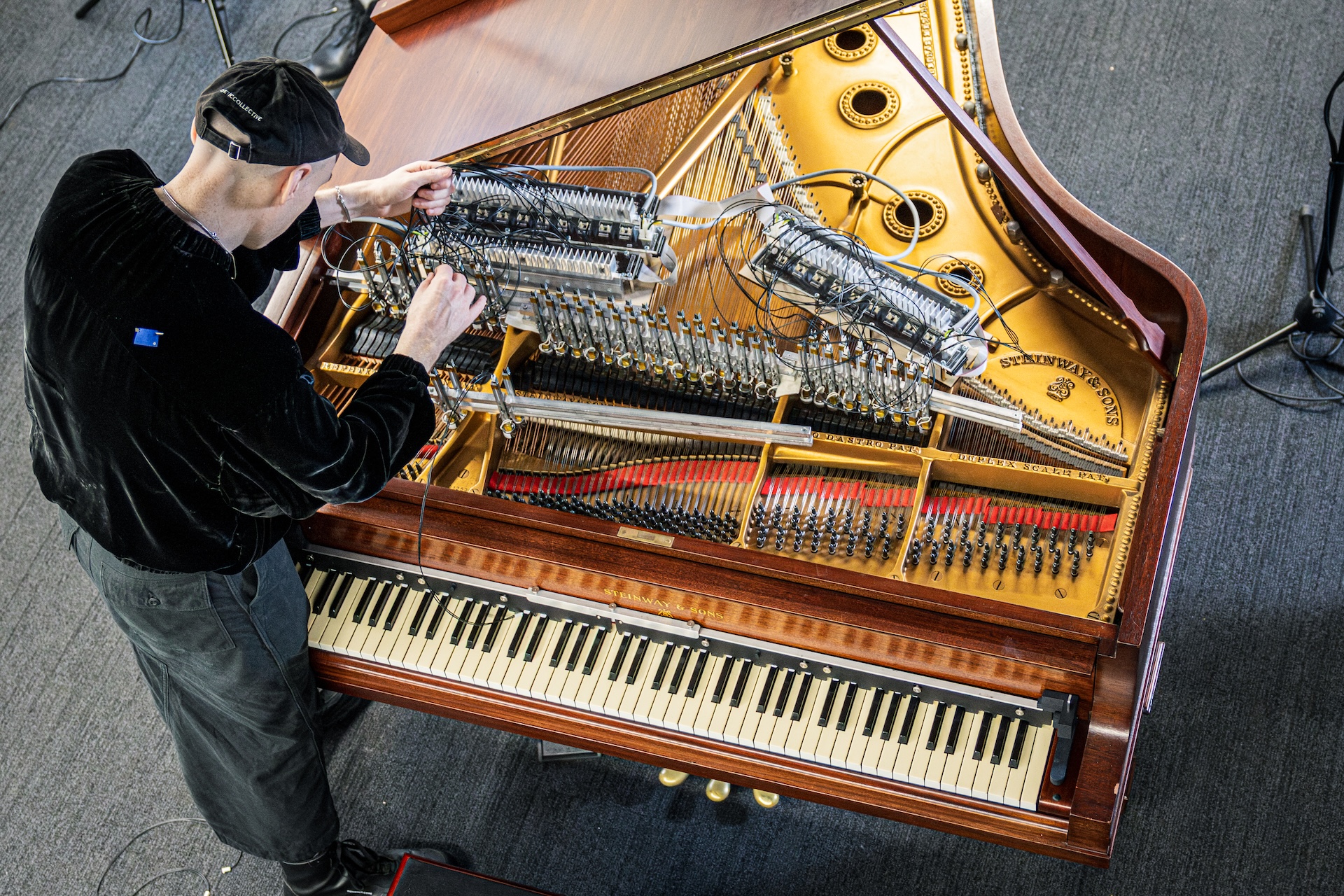
The magnetic resonator piano (MRP) is a hybrid acoustic-electronic instrument which uses electromagnets to vibrate the strings of a grand piano. The MRP extends the musical vocabulary of the piano to include infinite sustain, crescendos, pitch bends, harmonics and new timbres. All sound is produced acoustically by the strings and soundboard, without speakers. The instrument is played from the piano keyboard with a new scanner that measures the continuous angle of each key, enabling subtle and detailed new techniques for shaping the sound of the instrument. The MRP has been used in dozens of compositions and recordings and hundreds of performances worldwide, and new kits can be built on commission.
Why Augment the Piano?
The magnetic resonator piano is an augmented instrument: a traditional acoustic instrument whose sounds and playing techniques are extended with digital technology.
The design of the modern grand piano has barely changed in 150 years, and the familiar keyboard layout dates back centuries. Millions of people know how to play piano, and an enormous quantity of music has been written for it. By augmenting rather than replacing the piano, the MRP builds on centuries of lutherie, repertoire and performance practice while taking the instrument in new creative directions.
How it Works
The magnetic resonator piano kit can be installed in any acoustic grand piano. Two main innovations form the technical core of the instrument: electromagnetic string actuation and continuous key position sensing.
Electromagnetic String Actuation
Sound is produced on the MRP by using electromagnets to actuate (pull on) the strings of a grand piano. Piano strings are made of steel, which is a ferromagnetic material. This means that a magnet will exert a force on it, and an electromagnet driven by a time-varying electrical current such as an audio signal will exert a time-varying force on the string. If the driving signal is tuned to the harmonics of the string, the string will vibrate and can produce quite a loud sound. The amplitude, pitch and waveform of the electromagnet signal will affect the sound of the string.
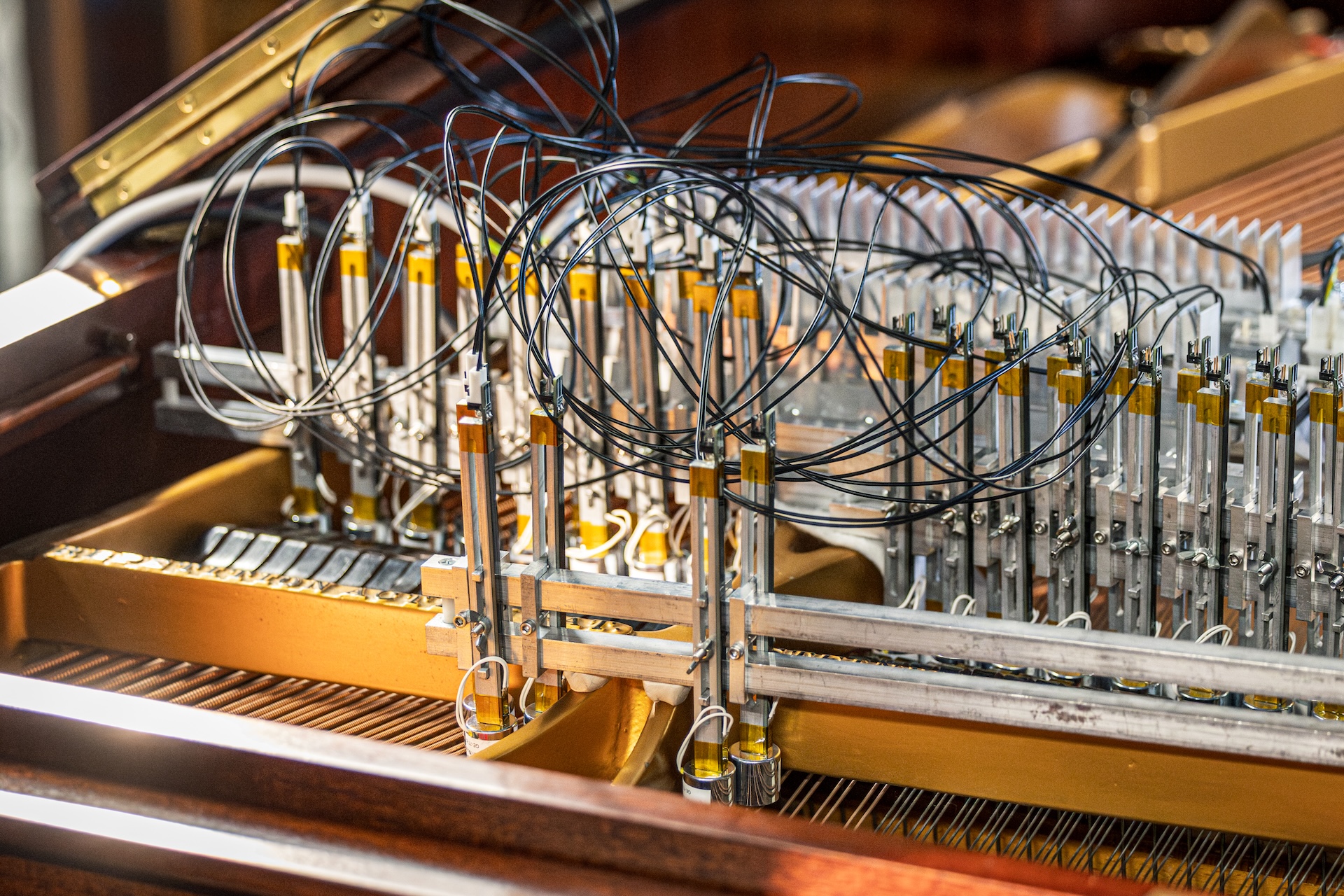
The MRP uses one electromagnet for each note of the instrument, up to 88 in total. These electromagnets are suspended a couple millimetres above the strings with metal brackets that rest on the piano frame. Every magnet has its own amplifier with a control box that connects the amplifiers to a computer audio interface.
Read about the engineering design of the MRP amplifier:
- The magnetic resonator piano: electronic augmentation of an acoustic grand piano'
- 'Techniques and circuits for electromagnetic instrument actuation'
Continuous Key Position Sensing
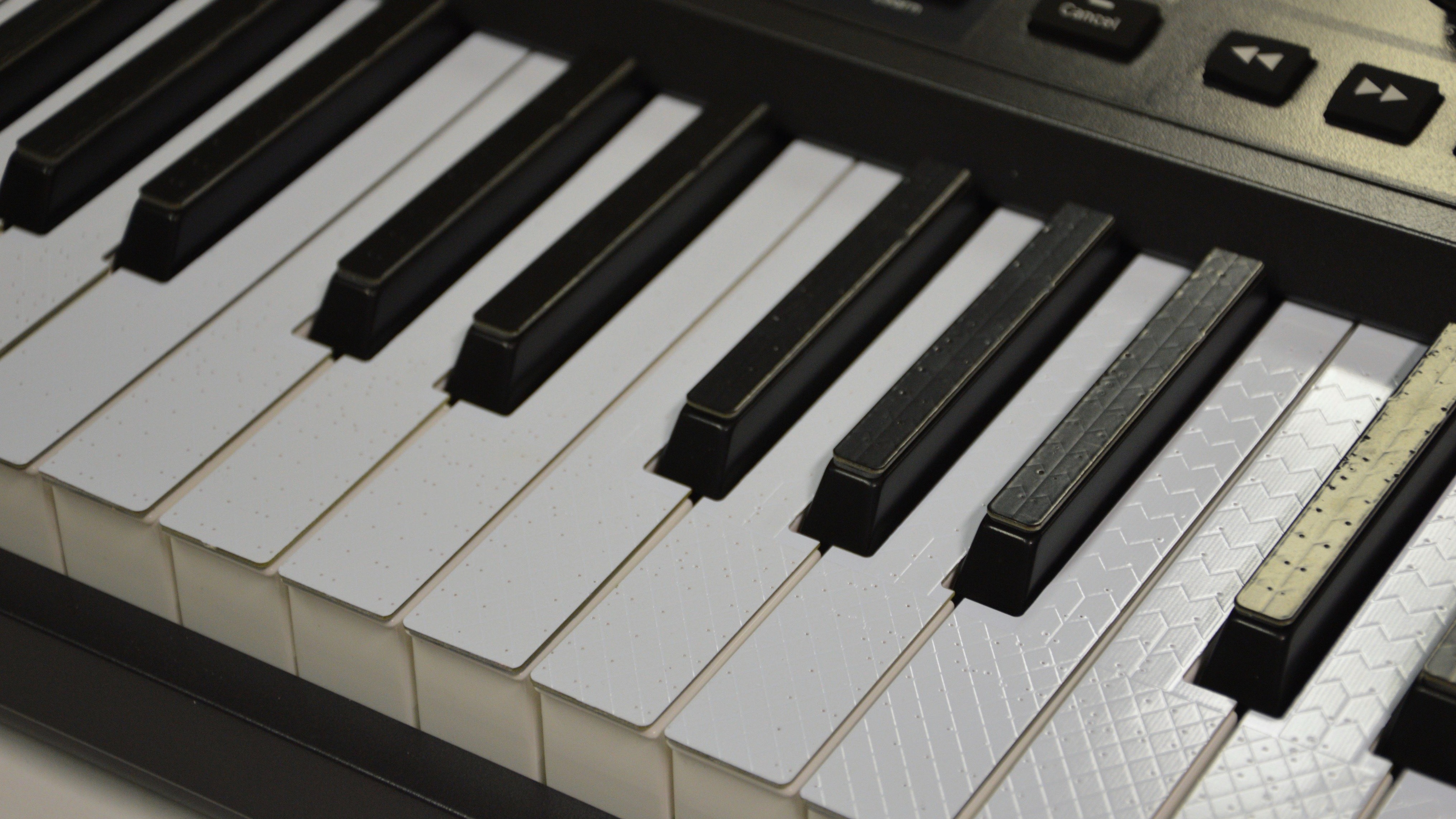
Another key innovation of the MRP is how the behaviour of the electromagnets is placed under the player’s fingertips alongside traditional piano technique. A sensor at the back of the keyboard (the [KeyScanner](link to follow)) uses optical reflectance sensors to measure the position of each key. It shines a small infrared light on the key surface and measures how much light comes back, measuring not just whether the key has been pressed, but exactly how far it has been pressed.
This means that, in addition to the usual techniques on a MIDI keyboard, it becomes possible to tell if a key is held halfway down, or measure subtle shaking or tapping gestures, even if they don’t fully depress the key. It’s also possible to measure force on a fully-pressed key, akin to aftertouch on MIDI keyboards. The MRP software translates all of these techniques into different sonic variations.
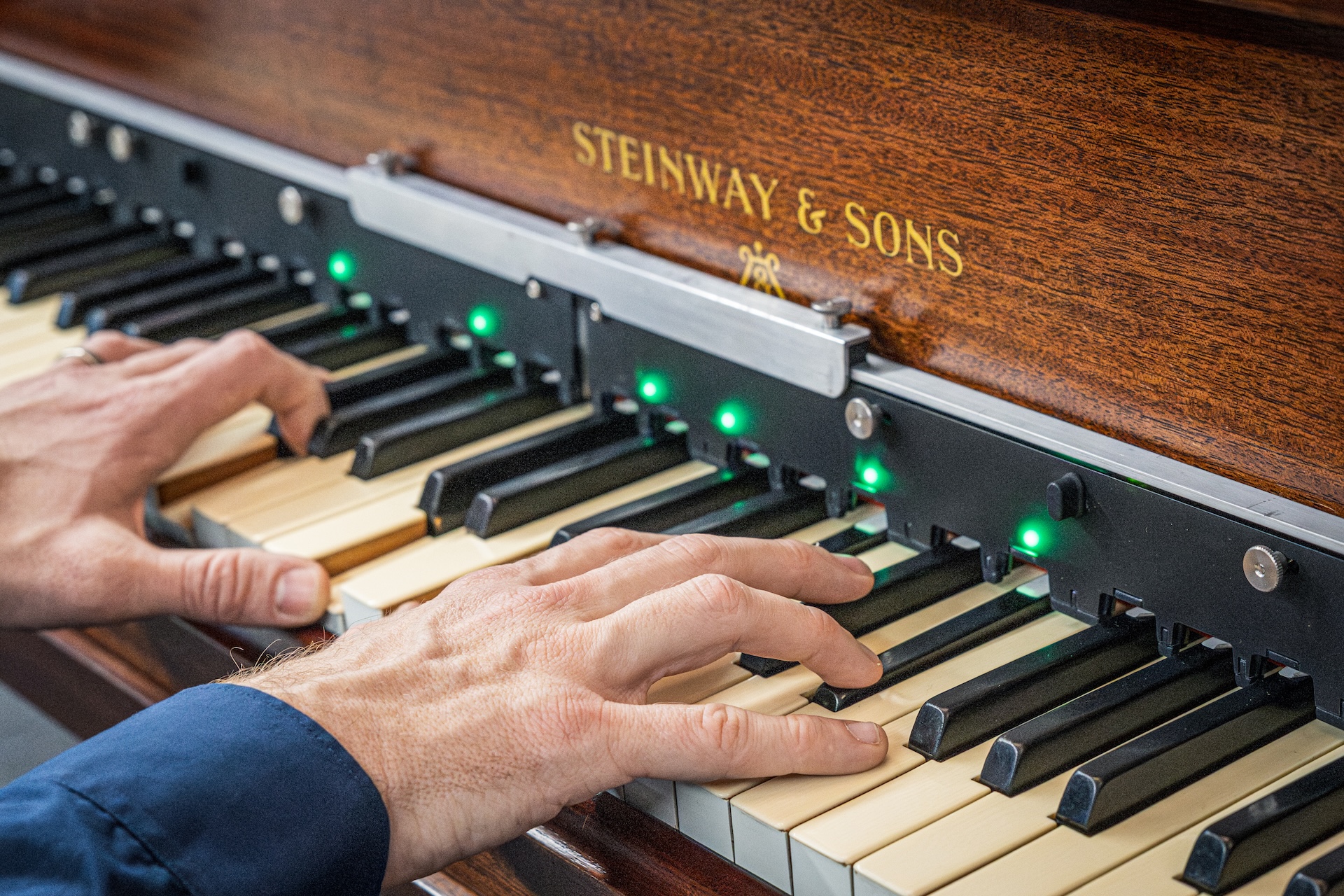
Because nothing obstructs the keys or hammers, it is possible to play sounds on the electromagnets alongside traditional piano. A volume pedal played by the pianist’s left foot controls the overall volume of the electromagnets, even as notes can also be controlled individually in great detail by how the player manipulates the keys.
Software
The MRP is a partially digital instrument: even though the sound is produced acoustically by the strings, there is software running on a computer to translate key movements into signals for the electromagnets. Some of the behaviour of this software is configurable, and it is possible to record and play back key position and electromagnet signals.
A graphical control panel helps with setting up and calibrating the instrument. However, in performance, the software is never the focus of the player’s attention: movements at the keys produce sound just as on an acoustic instrument.
Origins and Community Building
The MRP was first created by Andrew McPherson as part of his PhD dissertation at the University of Pennsylvania in 2009, alongside two compositions for the instrument, Secrets of Antikythera and d’Amore.
The first version of the instrument differs from the one in regular use today. Over the years, the MRP has gained continuous control from the keyboard, louder and more brilliant sounds from the magnets, new playing techniques, and improvements to mechanical robustness and ease of setup.
Since 2010, the instrument has been used by an ever-growing worldwide roster of composers, performers, improvisers and sound artists. The current musical identity of the instrument bears the imprint of all the musicians who have used it over the years. Notation, playing techniques, and sounds have evolved organically through different artists influencing one another.
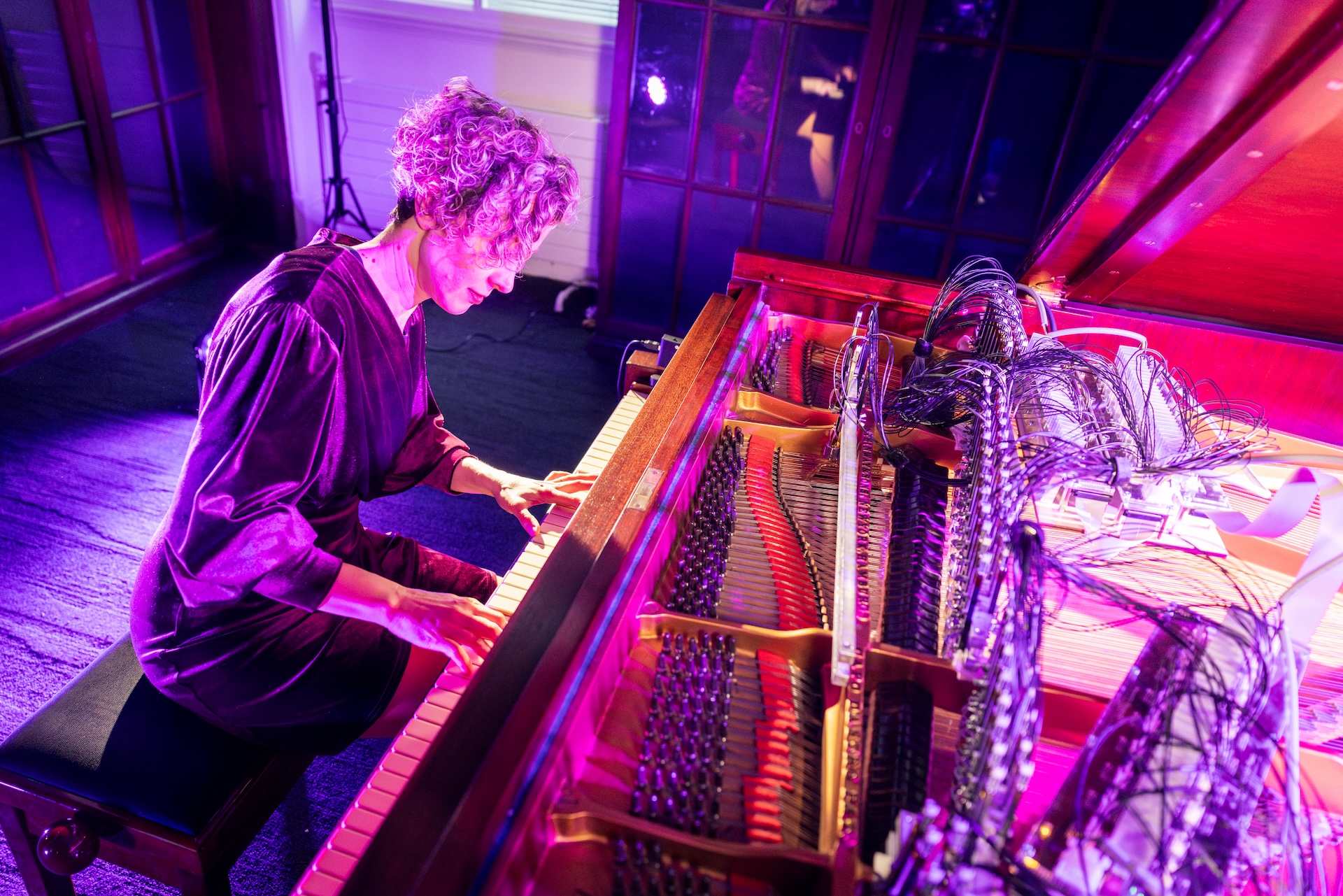
One particularly influential MRP performer is Xenia Pestova Bennett, whose compositions, improvisations and performances of other composers’ works have come to define the distinctive sound of the instrument. Many listeners also encounter the instrument through film scores by composers such as Jon Brion and Atli Örvarsson and performances by the electronic musician Arca.
Like many instruments, there always seems to be room for another artist to discover a new and unexpected sound or technique.
Read about community building with the MRP:
'The problem of the second performer: building a community around an augmented piano'
Repertoire and Discography
The MRP has seen extensive use across genres, including contemporary classical composition, jazz and rock albums, experimental and free improvised musics, installation art, and film scores.
Film and Television Scores
- L’Amour Ouf (Beating Hearts), score by Jon Brion (2024)
- Silo, score by Atli Örvarsson (2023)
- Christopher Robin, score by Jon Brion and Geoff Zanelli (2018)
Recordings
- Xenia Pestova Bennett: Atomic Legacies (Diatribe Records, 2020)
- These New Puritans: Field of Reeds (Infectious Music, 2013)
- Andrew McPherson: Secrets of Antikythera (Innova Recordings, 2013)
- Echo Collective: The See Within (Bandcamp, 2020)
- The Vernon Spring / Gwilym Gold: Still Live (Bandcamp, 2024)
- Kuba Pluzek: Book of Resonance (AudoCave, 2021)
- Jack Armitage: Strengjavera (Mengi Records, 2025)
Featured Performances and Installations
- Arca: The Light Comes in the Name of the Voice
- Gwilym Gold / Sam Beste: Vernon Spring
- Xenia Pestova Bennett: Glowing Radioactive Elements
- Jack Armitage: Strengjavera
Compositions
- Andrew McPherson, Secrets of Antiykthera (2009), 35’. Performances by Steve Beck, Sandra Gu and Ryan MacEvoy McCullough. Commercially released on Innova Recordings. Video
- Andrew McPherson, d’Amore (2009), 11’, for viola and MRP. Performances by Nadia Sirota, Bridget Carey and Rachel Ku. Commercially released on Innova Recordings.
- Andrew McPherson, Layers Deep Below (2011), 8’. Premiere by Andrew McPherson.
- David Carpenter, Job (2011), 13’, for baritone voice and MRP. Premiere by Lawrence Indik and Feifei Zhang.
- William Derganc, Play (2011), 6’, for violin and MRP. Premiere by Noco Kawamura and Matt Bengtson.
- Daniel Fox, Intermezzo (2011), 5’. Performances by Feifei Zhang and Hunter Noack. Video
- Daniel Shapiro, The Masons of Heidelberg (2011), 14’. Performances by Katya Popova, Elaine Chew and Nic Gerpe. Video: Mvt. I; Mvt. II; Mvt. III
- Jeff Snyder, Fantasy (2011), 10’. Performances by Eric Wubbels and Lola Perrin.
- Tony Solitro, Spectra of Morning (2011), 10’. Premiere by Feifei Zhang. Video
- William Dougherty, Emanations (2013), for violin, viola, cello, bass and MRP. Premiered by members of London Chamber Orchestra at Cadogan Hall, 17 May 2013.
- Pedro Faria Gomes, tereza’s dreams (2013), for 8-piece ensemble including MRP. Premiered by members of London Chamber Orchestra at Cadogan Hall, 17 May 2013.
- James Moriarty, Untempered by the Hand of Man (2013), for 5-piece ensemble including MRP. Premiered by members of London Chamber Orchestra at Cadogan Hall, 17 May 2013.
- Nick Morrish Rarity and Tim Morrish, Impulse.Pulse.Parted (2013), for 8-piece ensemble including MRP. Premiered by members of London Chamber Orchestra at Cadogan Hall, 17 May 2013.
- Andrew Thomas, Till Human Voices Wake Us (2013), for 6-piece ensemble including MRP. Premiered by members of London Chamber Orchestra at Cadogan Hall, 17 May 2013.
- Richard Peat, You leave it with me (2014), for magnetic resonator piano. Premiered by Neil Georgeson, QMUL, 25 October 2014.
- Ben Parker, Time Stopped and Snow Fell (2015). for magnetic resonator piano. Premiered by Ben Powell, Royal Northern College of Music (UK), 22 March 2015.
- Sergio Cote, piece for magnetic resonator piano (2015). Premiered by Leanne Cody, Royal Northern College of Music (UK), 22 March 2015.
- Julia Adolphe, Magnetic etudes (2015), for magnetic resonator piano. Premiered by Aron Kallay (People Inside Electronics), Neighborhood Unitarian Universalist Church of Pasadena, CA, 18 April 2015. Video: Mvt. I; Mvt. II; Mvt. III
- Jeremy Cavaterra, Gegenschein (2015), for magnetic resonator piano. Premiered by Steven Vanhauwaert (People Inside Electronics), Neighborhood Unitarian Universalist Church of Pasadena, CA, 18 April 2015. Video
- Alexander Elliot Miller, 88 MPH (2015), for magnetic resonator piano. Premiered by Nic Gerpe (People Inside Electronics), Neighborhood Unitarian Universalist Church of Pasadena, CA, 18 April 2015. Video
- Elise Roy, Sonatine (2015), for magnetic resonator piano. Premiered by Richard Valitutto (People Inside Electronics), Neighborhood Unitarian Universalist Church of Pasadena, CA, 18 April 2015. Video
- Oded Ben-Tal, Sonata (Scarlatti, Schubert, Scriabin) (2016), for magnetic resonator piano and live electronics. Premiered by Elaine Chew, Schott Music London, 24 June 2016.
- Jonathan Pitkin, l.v. (2017), for magnetic resonator piano. Premiered by Kate Ryder at the Royal College of Music on 23 November 2017.
- Xenia Pestova Bennett, Glowing Radioactive Elements (2018), for magnetic resonator piano. Premiered by Xenia Pestova at Royal Birmingham Conservatoire, 20 February 2018. Video from performance at Cafe Oto, April 2018: Mvt. I; Mvt. II; Mvt. IV
- John Young, Magnetic Resonance (2017), for magnetic resonator piano and live electronics. Premiered by Xenia Pestova at Royal Birmingham Conservatoire, 20 February 2018. Audio excerpt
- Rolf Hind, Other Avatars (2018), for magnetic resonator piano. Premiered by Rolf Hind at St. John’s Smith Square on 20 April 2018. Video
- Paul Max Edlin, …and the Body of Transformations (2018), for magnetic resonator piano. Premiered by Rolf Hind at Queen Mary University of London on 20 November 2018. Recording
- Xenia Pestova Bennett, Atomic Legacies (2019), for magnetic resonator piano and string quartet
- Luke Mombrea - Aurora (2023)
- Ollie Hawker - It’s not something I ever thought would be the case (2023)
- Rebecca Galian Castello - Wait in the Car (2023)
- Scott McLaughlin - Individuation Study #1: what ripples but does not break the surface (2023)
- Simon Hall - Xenia’s Mag(net)ic Piano (2019, with fixed media)
- Agnieszka Olek - Cloaked (2024)
- Dylan Murphy - Between Two Points (2024)
- Tristan Kersten - Cylene (2024)
- Rory Murphy - Acanthus (2024)
- Kristian Rasmussen - Rumination (2024)
- Avril Kneafsey - Sparkles (2024)
- Elaine McLoughlin - Waxing Gibbous (2024)
- Anne Marie Deacy - Cosmic Stethoscope (2024, with tuning forks, radios and field recordings)
Using or Commissioning a Magnetic Resonator Piano
The magnetic resonator piano is normally set up in the Augmented Instruments Laboratory at Imperial College London. Several other MRP kits have been commissioned in recent years for a variety of artists and institutions in Europe and North America.
An MRP kit is available to hire for performance and recording projects. With sufficient lead time, it is also possible to commission a new MRP kit. Please contact [Andrew McPherson] with any enquiries.